
 EN
EN



The Physics of Light as a Joining Tool
A laser welding machine converts electrical energy into a concentrated beam of light that melts metal at the joint interface, creating a fusion bond as the molten material solidifies. Unlike arc welding — which uses an electric arc between electrode and workpiece — or resistance welding — which passes current through the parts themselves — laser welding delivers energy without physical contact, through a beam focused to a diameter of 0.05–0.5mm.
The energy density at the focal point reaches 1–10 MW/cm², sufficient to vaporize metal within microseconds. When the beam strikes the workpiece, the surface absorbs approximately 60–80% of the incident energy at fiber laser wavelengths (1064nm for most industrial systems). The absorbed energy creates a molten pool — the weld puddle — that solidifies behind the advancing beam, creating the weld seam. The heat-affected zone (HAZ) — where material properties change without melting — extends only 0.1–2mm from the weld centerline, compared to 2–10mm for TIG welding. This narrow HAZ minimizes distortion and preserves material properties in the surrounding metal.
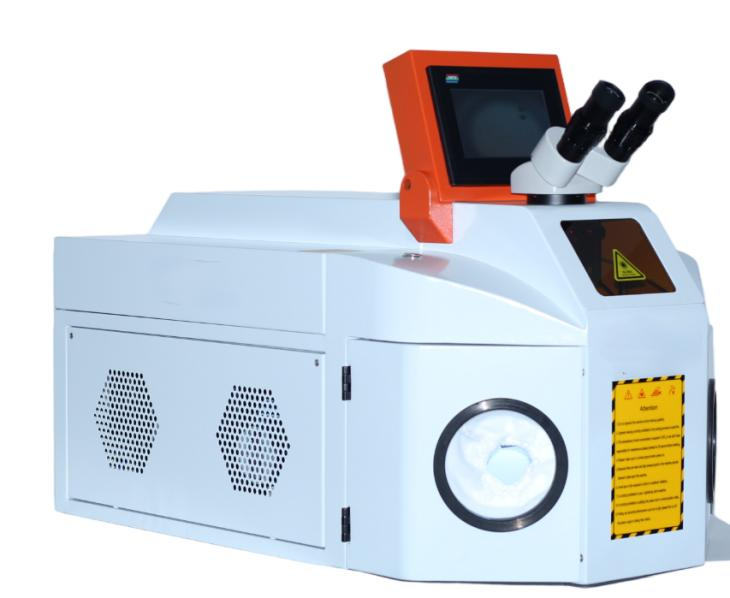
A jewelry manufacturer producing custom engagement rings adopted a desktop 150W laser welding machine to replace the gas torch soldering previously used for ring sizing and prong repair. The torch method heated the entire ring shank to soldering temperature, requiring re-polishing to remove heat discoloration and occasionally loosening adjacent stone settings through thermal expansion. The laser's 0.2mm beam diameter allowed the welder to add filler material precisely to the joint without heating the surrounding structure. Post-weld cleanup time dropped approximately 70%, and the elimination of open flame in the workshop removed the fire insurance premium surcharge the studio had been paying.
Laser Welding Modes and Applications
Conduction Mode Welding
Conduction mode welding — where the laser heats the surface and the heat conducts into the material to create the weld pool — operates at power densities below approximately 10⁶ W/cm². The weld is wide and shallow with an aspect ratio (depth/width) of approximately 0.5–1.0. Conduction mode welding suits thin materials (0.1–1mm), applications requiring smooth seam appearance, and materials sensitive to cracking at high cooling rates.
The desktop laser welding machine used in electronics and jewelry manufacturing operates primarily in conduction mode. Welding speed of 10–20mm/s produces seams 0.5–1.5mm wide on stainless steel, aluminum, titanium, and precious metals. The lower power density eliminates the keyhole instability that can cause porosity in conduction-sensitive applications like hermetic seam sealing of electronic packages where a single pore in the weld means a failed leak test.
Keyhole Mode Welding
At power densities above 10⁶ W/cm², the laser vaporizes metal at the beam center, creating a narrow cavity — the keyhole — surrounded by molten metal. The keyhole acts as a blackbody radiation trap, absorbing nearly 100% of the incident beam energy through multiple reflections within the cavity. This deep penetration mode produces weld aspect ratios of 5–10:1, joining material up to 10mm thick in a single pass without the multi-pass buildup that arc welding requires.
Handheld fiber laser welding systems at 1,000–3,000W bring keyhole welding capability to applications previously requiring fixed automation. The operator holds a welding head weighing 1–2kg that delivers the focused beam through a flexible fiber optic cable from the laser source cabinet. The handheld form factor allows welding large assemblies, field repairs, and structural fabrication that cannot fit inside a fixed welding enclosure.
Comparison with Traditional Welding Methods
Heat input differentiates laser welding from arc processes. TIG welding deposits approximately 500–2,000 J/mm of weld length. Laser welding deposits 50–300 J/mm — roughly 5–10× less energy per unit length. The reduced heat input means less distortion, faster cooling, and the ability to weld near heat-sensitive components that arc welding would damage.
For thin materials (0.5–2mm), laser welding speed of 500–2,000mm/min exceeds TIG speed of 100–300mm/min by a factor of 3–7×. The speed advantage diminishes on material above approximately 4mm, where multiple laser passes or hybrid laser-arc processes may be required. The productivity crossover depends on material thickness, joint configuration, and whether post-weld grinding — significantly reduced with laser welding due to minimal spatter — is included in the total process time calculation.
Frequently Asked Questions
What materials can a laser welding machine join?
Fiber laser welders join steel, stainless steel, aluminum, titanium, copper, brass, and nickel alloys. Dissimilar metal welding — steel to copper, stainless to titanium — is possible with appropriate filler material and parameter optimization. Reflective metals like copper and aluminum require back-reflection protection in the laser source.
How thick can laser welding penetrate in a single pass?
Fiber lasers at 1,500–3,000W achieve 2–4mm penetration in keyhole mode on steel. Multi-kilowatt systems at 6,000–10,000W achieve 8–12mm single-pass penetration. Beyond these thicknesses, hybrid laser-arc welding combines laser penetration with arc filler deposition for thick-section joining.
Is laser welding safe for operators without full enclosure?
Handheld laser welding systems require laser safety eyewear rated for the specific wavelength (OD 5+ at 1064nm), protective clothing, and a controlled access area. Full enclosure Class 1 systems contain the beam within a light-tight housing and require no personal protective equipment. Safety classification depends on system design, not laser power.
What training is required for laser welding operation?
Handheld laser welding requires 2–5 days of training covering beam control, parameter selection, and safety protocols. Desktop fixed-beam systems require similar training with emphasis on fixture design and motion programming. Prior welding experience accelerates learning but is not required. Tianyu Laser provides 2–3 day installation and operator training with equipment delivery.
How does laser welding cost compare to TIG welding?
Laser welding equipment costs 5,000–25,000 versus 500–3,000 for TIG. Labor productivity gains — 3–5× faster welding speed, 70% less post-weld finishing — recover the equipment premium within 12–24 months for applications above 1,000 welding hours annually. The consumable savings — no tungsten electrodes, filler rod consumption reduced 50–70% — provide additional recurring savings.
Can a laser welding machine also perform laser cleaning?
Some dual-function systems offer both welding and cleaning modes by adjusting beam parameters. Dedicated laser cleaning systems use different optics and scanning patterns optimized for contamination removal. Combining both functions in one machine compromises performance on each — separate systems produce better results for heavy production applications.