
 EN
EN


Matching Marking Technology to Application Requirements
Selecting a fiber laser marking machine begins with defining two parameters: the materials to be marked and the required throughput. A system optimized for deep engraving on 100 steel tools per day differs fundamentally from a system marking QR codes on 5,000 aluminum parts per shift. Getting these parameters right determines whether the machine becomes a production bottleneck or capacity surplus.
Fiber lasers excel on metals — steel, stainless steel, aluminum, titanium, brass, copper — and mark some dark-colored plastics like ABS and polycarbonate. If the application includes clear plastics, glass, or silicon, a UV laser (355nm) is required instead. If the application includes wood, paper, or leather, a CO₂ laser (10,600nm) is the appropriate technology. The material rule is straightforward: metals and engineered dark plastics = fiber; heat-sensitive materials = UV; organics = CO₂.
A tool manufacturer producing 2,000 torque wrenches daily needed a marking system that could engrave serial numbers and calibration data at consistent depth. The requirement was 0.05–0.08mm engraving depth — deep enough to survive tool wear, shallow enough to avoid creating stress concentrations. A 30W fiber marker was selected over a 20W system because the deeper engraving required the additional power to achieve the 2-second cycle time that the production line demanded. A 20W could achieve the depth but required 3.5–4 seconds per unit, creating a bottleneck at the marking station.
Key Specification Decisions
Laser Power Selection
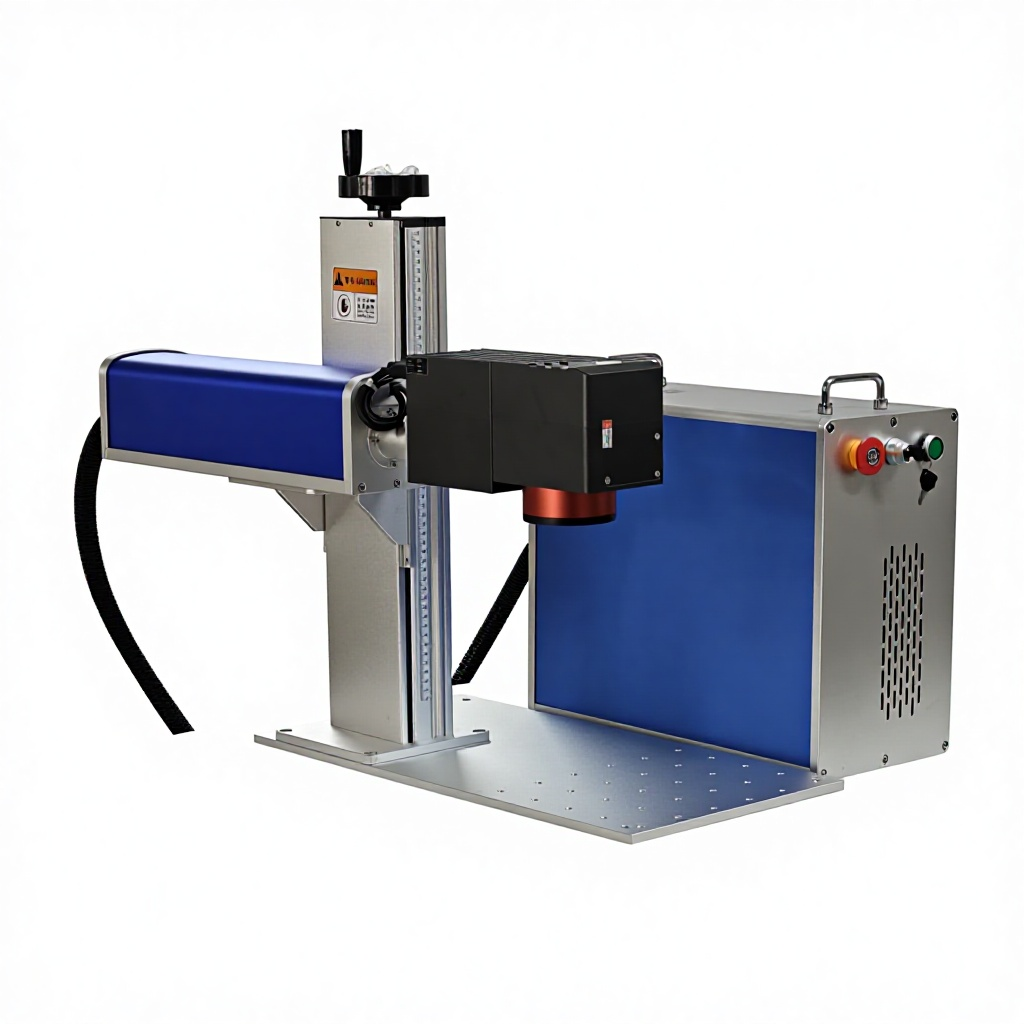
Fiber fiber laser marking machine power ranges from 20W to 100W, but higher power does not always mean better results. For surface marking — annealing, color change, and light ablation — 20–30W provides sufficient power density with the flexible parameter range to mark everything from thin aluminum to thick steel. For deep engraving — 0.05mm+ material removal on hardened steel — 50W+ power reduces processing time proportionally to additional wattage.
The MOPA (Master Oscillator Power Amplifier) versus Q-switch decision affects application capability more than raw wattage. Q-switched lasers produce nanosecond pulses at fixed pulse duration — typically 100–200ns — adequate for standard black and white marking on metals. MOPA lasers allow adjustable pulse duration from 2ns to 500ns, enabling color marking on stainless steel and titanium, black marking on anodized aluminum without coating damage, and superior contrast on plastics. The MOPA premium adds 30–50% to system cost but expands application range significantly.
Laser Source Brand and Reliability
The laser source represents the most expensive consumable in the system, with replacement costs of 1,000–5,000 after its rated lifetime. Major brands include IPG (Germany/USA, 100,000-hour rated life), Raycus (China, 100,000-hour), Max Photonics (China, 80,000–100,000-hour), and JPT (China, MOPA specialist, 80,000+ hour). Brand selection affects not only longevity but also beam quality — the M² factor describing how closely the beam approximates an ideal Gaussian profile.
Beam quality determines the smallest achievable spot size and therefore the finest detail the machine can mark. An M² of 1.3 produces a spot size of approximately 20–30 microns — sufficient for QR codes as small as 3×3mm. An M² of 2.0 produces a spot size of 40–50 microns, limiting QR code minimum size to approximately 5×5mm. Electronics manufacturers marking micro-QR codes on components smaller than a fingernail need the M² specification — not power — as their primary selection criterion.
Marking Area and Lens Configuration
The scanning lens — called an F-theta lens — determines the marking field size and the relationship between field size and spot size. A 110×110mm lens produces the smallest spot and finest detail but limits marking area. A 200×200mm lens covers four times the area but with a proportionally larger spot size. The lens cannot be changed mid-operation, so the largest part dimension plus positioning tolerance determines the lens selection.
For applications requiring both a large field and fine detail, a 3D dynamic focusing system adds 3,000–6,000 and allows the focal plane to adjust continuously across the marking field, compensating for surface height variations and enabling marking on curved or stepped surfaces that would be out of focus on a fixed-focus system.
Frequently Asked Questions
What power fiber laser marker do I need?
20–30W covers 90% of surface marking applications on metals. 50W+ is needed for deep engraving (0.05mm+) or throughput exceeding 5,000 parts per shift. 100W systems address heavy engraving on hardened tool steel. Power requirement is determined by material, desired mark depth, and cycle time — not part size alone.
What is the difference between Q-switch and MOPA fiber lasers?
Q-switched lasers produce fixed-duration pulses suitable for standard black/white metal marking. MOPA lasers allow adjustable pulse duration (2–500ns), enabling color marking on stainless steel, black marking on anodized aluminum, and high-contrast marking on engineering plastics. MOPA systems cost 30–50% more.
How long does a fiber laser source last before replacement?
Fiber laser sources are rated for 80,000–100,000 hours of operating time — approximately 10–15 years of single-shift operation. The galvanometer scanning system and control electronics typically outlast the laser source. Tianyu Laser uses Raycus, Max, JPT, and IPG sources with documented lifetime ratings.
Can one fiber laser machine mark both metals and plastics?
Yes, but with limitations. Fiber lasers mark dark-colored plastics (black ABS, dark polycarbonate) effectively through carbon migration. Light-colored and transparent plastics require UV laser marking. Mixed metal-plastic production environments may need both fiber and UV systems rather than one universal solution.
What software and file formats does a fiber laser marking machine support?
Standard systems run EZCAD2 software supporting AI, PLT, DXF, PNG, JPG, BMP, and direct barcode/QR code generation. Premium systems offer custom database integration for automated serial number generation and MES connectivity. Tianyu Laser machines are compatible with CorelDRAW, AutoCAD, and Photoshop workflows.
How much floor space does a fiber laser marking machine require?
Desktop systems occupy approximately 0.5m² including the computer workstation. Enclosed production systems with safety housing and integrated conveyor occupy 1–2m². Handheld fiber markers weigh under 6kg and require no permanent installation — they are deployed to the workpiece rather than transporting workpieces to the machine.