
 EN
EN


The Technology Behind Permanent Marking
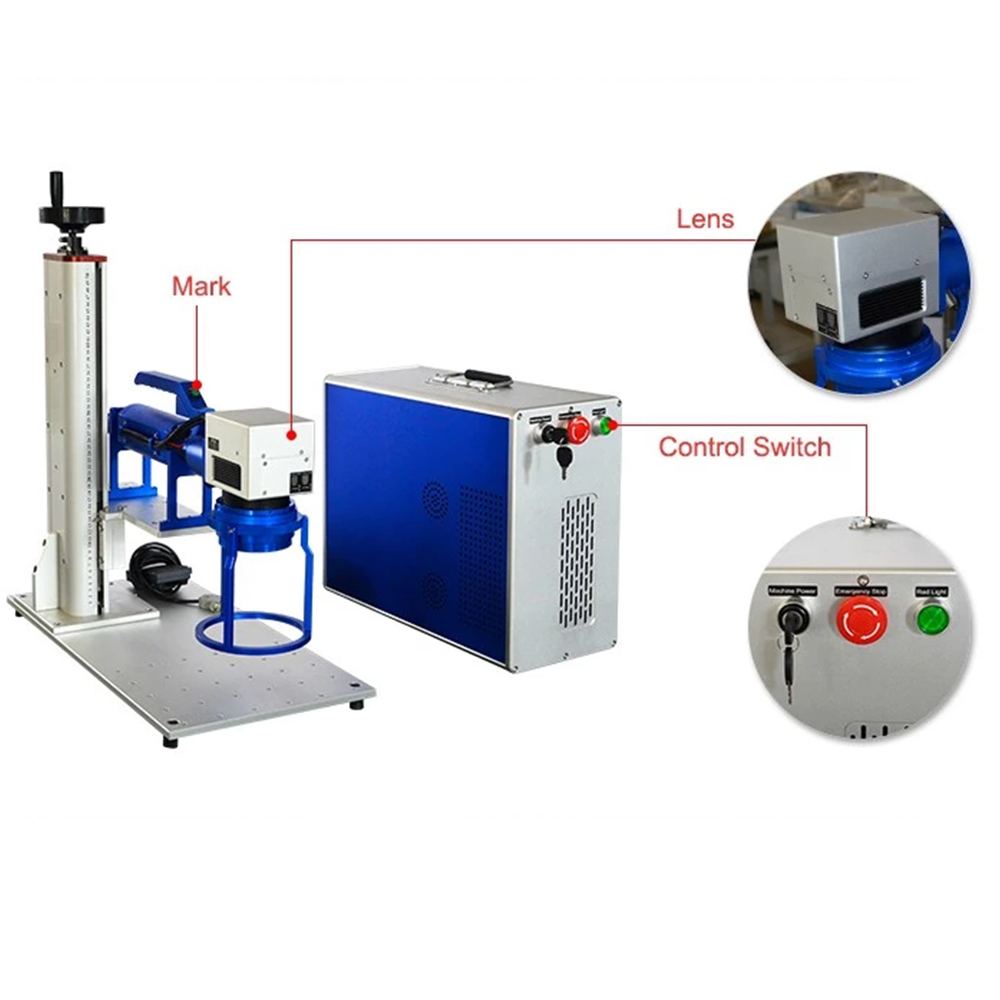
A laser marking machine uses a focused beam of amplified light to create permanent marks on material surfaces without physical contact, inks, or mechanical tooling. Unlike inkjet printing that deposits ink onto the surface or dot-peen marking that deforms the material through impact, laser marking modifies the material itself — changing its color through oxidation, removing a thin surface layer to reveal contrasting substrate, or altering surface texture to create visible contrast.
The process works through four distinct mechanisms depending on the material and desired result. Annealing — common on stainless steel and titanium — heats the metal surface locally to create an oxide layer whose color varies with temperature, producing black, brown, or colored marks without material removal. Carbon migration marking on plastics and organic materials darkens the surface through localized heating without ablation. Engraving removes 0.01–0.1mm of material, creating depth-perceptible marks. Ablation removes surface coatings — anodized layers, paint, plating — to expose the contrasting material beneath.
A stainless steel kitchenware manufacturer replaced screen printing with a 20W fiber laser marking machine for applying brand logos and care instructions to cookware. The screen printing process required ink curing, wore screens after approximately 5,000 impressions requiring replacement at 80–120 per screen, and produced markings that faded after 200–300 dishwasher cycles in consumer testing. The fiber laser applied marks through annealing in 1–2 seconds per logo without consumables, producing marking that withstood 1,000+ dishwasher cycles without degradation. The per-unit marking cost dropped from approximately 0.04 (screen+ink+reject amortization) to less than 0.001 (electricity only).
Material-Specific Marking Mechanisms
Fiber Laser Marking on Metals
Fiber laser marking machine systems emit at 1064nm wavelength — a near-infrared wavelength that metals absorb efficiently. On stainless steel, the laser can produce black annealed marks (surface heating to 200–300°C creating chromium oxide), white marks (surface texturing that scatters light differently), or deep engraving (0.05–0.1mm material removal for serial numbers resistant to grinding).
Aluminum marking uses slightly different parameters than steel. The lower melting point (660°C versus 1,400°C) requires reduced power density to prevent melting rather than marking. Anodized aluminum is marked by ablating the dye-colored oxide layer to expose the bright aluminum beneath — a process requiring only 10–20% of the power needed for bare aluminum marking because the laser is removing a micron-thin coating rather than modifying the metal.
The key advantage of fiber marking on metals is permanence. Annealed marks on stainless steel survive salt spray testing for 1,000+ hours, autoclave sterilization cycles, and chemical exposure from industrial cleaning agents — conditions that remove printed labels and ink markings within weeks or months. This durability makes fiber laser marking the standard for medical device UDI compliance, aerospace part traceability, and automotive component identification.
UV Laser Marking on Sensitive Materials
UV lasers at 355nm mark materials that fiber lasers at 1064nm would damage through heat. Plastics — ABS, polycarbonate, polypropylene, nylon — mark through a photochemical reaction rather than thermal effect. The high-energy UV photons break polymer molecular bonds directly, creating a color change at the surface without melting or deforming the substrate.
This "cold marking" capability enables applications impossible with fiber or CO₂ lasers. Silicon wafers receive wafer ID marking without micro-cracking. Medical catheters receive UDI codes without surface damage that could harbor bacteria. Transparent PET bottles receive date codes visible only under specific lighting — called "frost marking" — that preserves the transparent appearance while providing traceability.
Glass marking with UV lasers eliminates the micro-cracking that CO₂ laser marking produces on glass surfaces. The 355nm wavelength is partially absorbed by glass, creating a smooth frosted mark without the stress concentrations that cause glass to fracture along CO₂-marked lines.
Frequently Asked Questions
What materials can a laser marking machine process?
Fiber lasers mark metals (steel, aluminum, titanium, brass, copper) and some dark plastics. UV lasers mark plastics, glass, ceramics, silicon, and thin films. CO₂ lasers mark wood, paper, leather, acrylic, and glass. Tianyu Laser offers fiber, UV, and CO₂ systems covering the complete material spectrum.
How long does laser marking take per part?
Marking time depends on content complexity, size, and material. A simple logo or serial number on metal typically takes 1–3 seconds. A filled QR code or detailed graphic on a 50×50mm area takes 5–15 seconds. Production throughput for automated systems ranges from 500–3,000 parts per hour.
Is laser marking permanent or can it be removed?
Annealed marks on stainless steel and carbon migration marks on plastics are permanent — they are chemical changes to the material, not surface deposits. Engraved marks require grinding 0.05mm+ of surface material for removal. Ablated coating marks (anodized aluminum, painted surfaces) expose substrate and cannot be "unmarked" without re-coating.
Does laser marking require consumables like ink or solvents?
No. Fiber and UV laser markers operate without consumables — no ink, solvent, ribbons, or printheads. The laser source requires replacement after 10,000–100,000 hours depending on type. Electricity consumption at 500–800W is the only recurring cost per operating hour beyond labor.
Can a laser marking machine create colored marks?
Yes, through MOPA (Master Oscillator Power Amplifier) fiber laser technology. By controlling pulse duration and frequency, MOPA lasers produce a spectrum of colors on stainless steel and titanium — from gold through blue to black — by precisely controlling oxide layer thickness. Standard Q-switched fiber lasers produce only black or white marks.
What file formats do laser marking machines accept?
Standard systems accept AI, PLT, DXF, PNG, JPG, and BMP formats through EZCAD or similar software. Barcode and QR code generation is built into the software — no external design application required. Tianyu Laser machines support importing from CorelDRAW, AutoCAD, and Photoshop for seamless workflow integration.