
 EN
EN


Breaking Down UV Laser Marking Machine Pricing
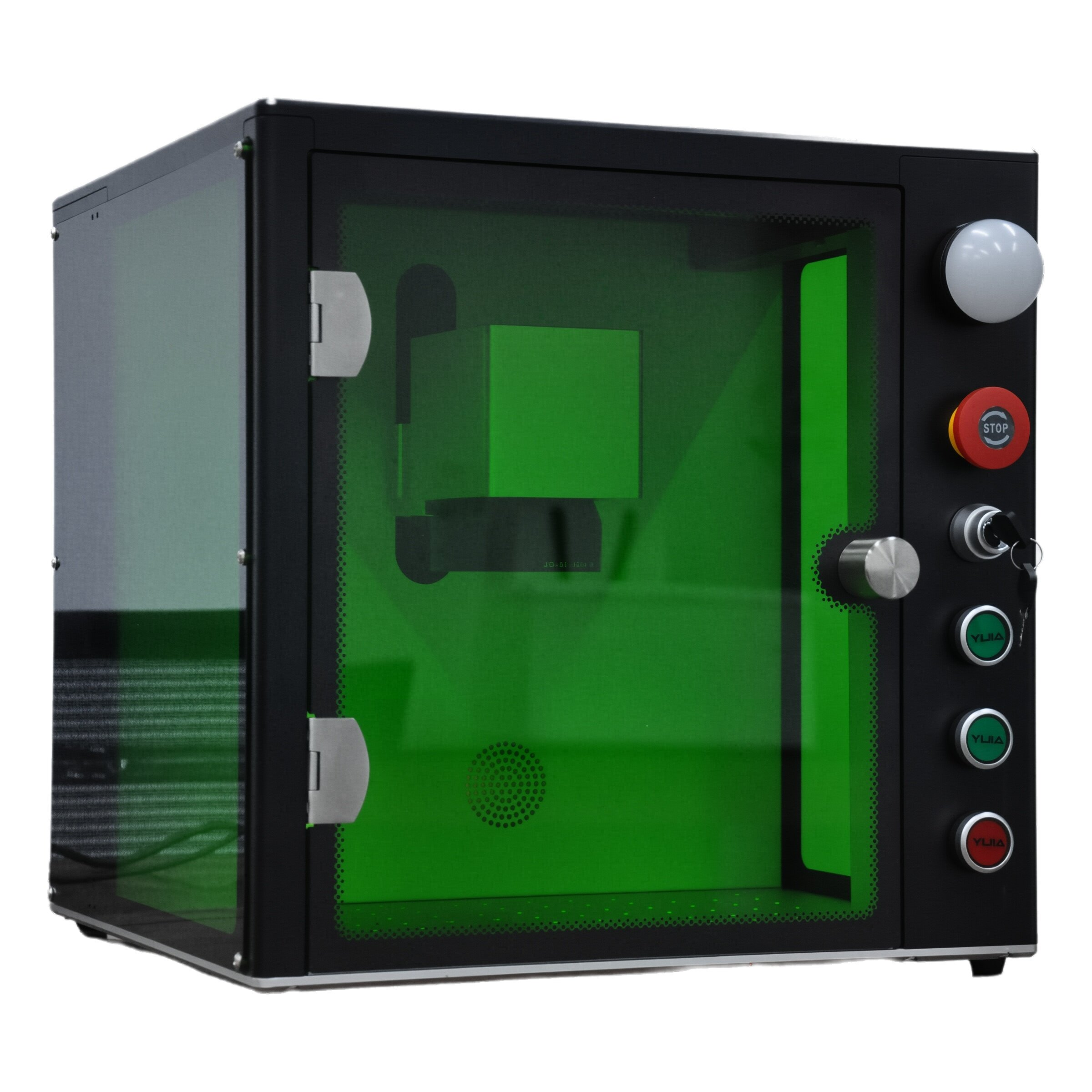
A uv laser marking price typically ranges from 3,000 to 25,000 depending on power output, automation level, and the laser source brand. Entry-level 3W UV desktop markers designed for small-batch plastic and glass marking start near 3,000–5,000. Mid-range 5W–10W systems for production-line integration range from 8,000–15,000, while high-power 15W+ industrial UV markers with conveyorized automation and vision positioning systems reach 18,000–25,000.
The price spread exists because UV laser marking uses a fundamentally different technology than fiber marking. UV lasers operate at 355nm wavelength — one-third of the fiber laser's 1064nm — through a process called third harmonic generation. An infrared laser beam passes through two nonlinear crystals that double, then triple the frequency. Each crystal conversion loses energy, requiring higher-power pump diodes and precision optical alignment that increase manufacturing cost. The shorter wavelength produces "cold marking" — the 355nm photons break molecular bonds through photochemical reaction rather than heating the material surface, allowing marking on heat-sensitive substrates like plastics, glass, and silicon wafers without thermal damage.
A medical device manufacturer producing plastic syringe barrels with UDI (Unique Device Identification) codes compared the total cost of UV laser marking against inkjet printing over three years. The UV marker's 12,000 purchase price exceeded the inkjet printer's 4,000. However, the inkjet system consumed 300 monthly in ink cartridges, solvents, and printhead replacements — 10,800 over three years — while the UV laser operated with zero consumable cost beyond electricity. The UV system's total three-year cost of approximately 12,500 (purchase plus electricity) was 16% lower than the inkjet's 14,800 total, with the added advantage of permanent, solvent-resistant marking that eliminated the secondary curing step required for inkjet codes.
Factors Driving UV Laser Marking Machine Cost
Laser Source Brand and Quality
The uv laser marking price correlates strongly with laser source origin. Third-generation domestic Chinese UV sources (3W–5W) power 3,000–6,000 systems. Established Chinese brands like Huaray and Inno offer improved beam quality and 10,000–20,000-hour diode life at 6,000–12,000 system pricing. Imported sources from Spectra-Physics or Coherent push system prices above $15,000 but deliver 20,000–30,000-hour life and superior pulse-to-pulse stability for applications requiring sub-0.01mm repeatability on medical or semiconductor components.
The laser source represents approximately 40–50% of the total machine cost. The galvanometer scanning system — the motorized mirrors steering the beam across the marking area — accounts for 15–20%. The control electronics, enclosure, and workholding fixture comprise the remaining 30–40%. This cost distribution means that comparing UV markers by wattage alone is misleading: a 5W system with a premium galvanometer and precision X-Y table may outperform a 10W system with economy scanning components on applications demanding positional accuracy over raw speed.
Automation and Software Features
Vision positioning systems that automatically detect part location and rotate the marking field to match add 2,000–5,000 to system cost. Rotary axis attachments for cylindrical part marking add 800–2,000. Conveyor integration for in-line production marking adds 3,000–8,000 depending on conveyor length and part handling complexity.
The control software differentiates similarly priced hardware. Entry-level systems use EZCAD2 with basic text and barcode generation. Premium systems offer custom software with database connectivity for serial number generation, vision system integration, and MES (Manufacturing Execution System) communication protocols. Software capability determines whether the marker functions as a standalone engraving tool or an integrated production cell component.
Frequently Asked Questions
What is the typical price range for a UV laser marking machine?
UV laser markers range from 3,000–5,000 for entry-level 3W desktop units to 15,000–25,000 for industrial 15W+ systems with automation. The fiber laser alternative for metal marking is 30–50% less expensive for equivalent power because UV's third harmonic generation adds optical component cost. Tianyu Laser provides UV marking solutions across this full price range.
Why are UV laser marking machines more expensive than fiber markers?
UV lasers require two nonlinear crystals for third harmonic generation (1064nm → 532nm → 355nm), adding optical complexity and cost. The shorter wavelength demands higher-purity optical components. UV laser diodes also degrade faster than fiber laser diodes, requiring more expensive pump sources. These factors add 30–60% to manufacturing cost compared to equivalent-power fiber markers.
What ongoing costs should buyers budget beyond the purchase price?
UV laser markers have minimal consumable costs — no inks, solvents, or replacement printheads. Electricity consumption at 500–800W costs 0.05–0.08 per operating hour. Laser diode replacement after 10,000–30,000 hours represents the major lifecycle cost at 1,000–5,000 depending on source. Total operating cost excluding labor averages 0.10–0.20 per hour.
How does UV laser marking ROI compare to inkjet or label printing?
UV laser marking typically achieves ROI within 12–24 months for applications exceeding 100,000 marks annually through consumable elimination. Inkjet systems incur 200–500 monthly in consumables; UV systems incur near-zero. The breakeven calculation must include the labor savings from eliminating the inkjet's daily printhead cleaning and calibration routine.
What power level is appropriate for common UV marking applications?
3W handles plastics, silicone, and thin-film marking at 5,000–7,000mm/s. 5W adds capability for glass marking and deeper engraving on engineering plastics. 10W–15W systems handle high-speed production lines at 10,000+mm/s and can mark some thin metal foils. Power selection depends on throughput requirements more than material — a 3W system can mark most materials, just more slowly.
Do UV laser markers require special facility preparation?
UV markers need stable electrical supply (110V/220V, 50/60Hz), clean ambient air to prevent optics contamination, and temperature control (15–35°C) for beam stability. Unlike CO₂ markers, no gas supply or external cooling water is required. Tianyu Laser provides installation guidance and 2–3 day operator training with equipment delivery.