 ×
×
Oct 10,2026
TIANYU Laser · 30-Day Laser Cleaning Series · No. 03 · 5 min read
#LaserCleaning#PulseWidth#RustRemoval#WeldPrep#TIANYULaser
No hand-waving. Below are the seven points that decide which mechanism your machine is actually using — and what it means on your shop floor.
"Burn" is photothermal: light becomes heat, heat melts or vaporizes the contamination.
"Blast" is photomechanical: light becomes a pressure wave, and the pressure wave ejects the contamination.
Every industrial laser does some of each. The only useful question is which one dominates — and that is a spec, not an opinion.
A nanosecond pulse dumps its energy into the oxide layer faster than heat can spread. The oxide flashes to plasma, expands violently, and lifts off on a micro-shockwave — taking the contamination with it while the base metal underneath barely warms.
The number that matters is peak power. Run a 500 W pulsed unit at 100 ns and 50 kHz: that is 10 mJ per pulse, and a peak power of roughly 100 kW.
That 200× spike is the "blast." Nothing on the label tells you this — you have to do the division.

▴ Selective absorption at 1064 nm — the oxide takes the energy, the polished steel reflects it back.
A CW laser has no pulse to spike. It delivers its rated power continuously, so the heat has time to conduct into the base metal. The contamination melts and vaporizes — and so does a thin layer of the part you wanted to keep.
That is why a 6 000 W CW head is brilliant on thick mill scale and a liability on a 1.5 mm panel.
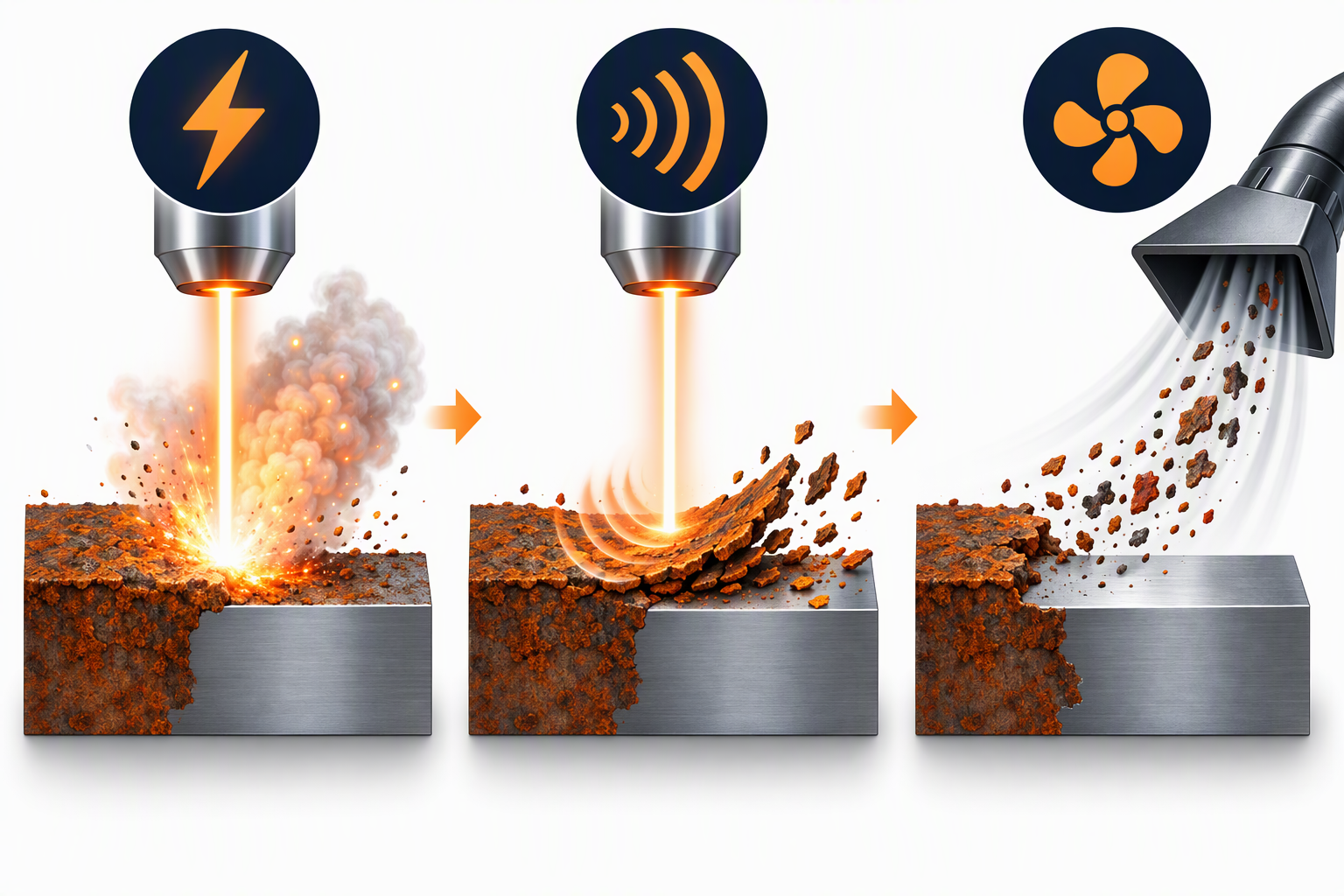
▴ The three stages of a "blast": absorb → vaporize → eject. The whole cycle lasts microseconds.
Shorter pulses = higher peak power = more blast, less burn. Longer or continuous = more burn, less blast. That is the entire trade-off, in one table.
| Laser mode | Pulse width | Peak vs. average power | Dominant mechanism | Heat into base metal |
|---|---|---|---|---|
| CW (continuous) | none — always on | 1× | Thermal (burn / melt) | High — 0.5–2 mm HAZ |
| ms pulsed | 0.5–20 ms | ~2–20× | Mostly thermal | Medium |
| µs pulsed | 1–500 µs | ~20–200× | Mixed | Low–medium |
| ns pulsed | 1–200 ns | ~100–1,000× | Mechanical (blast) | Very low — 5–20 µm |
One more number that rarely makes it onto a datasheet: duty cycle. At 100 ns and 50 kHz the beam is on for about 0.5% of the time. The surface spends the other 99.5% cooling down. That is why a pulsed head can clean a 0.1 mm weld seam without distorting it.
You do not need a thermal camera. Any two of these four on the workpiece means your parameters — or your machine type — are wrong for the job.
| Signal | What you see | What it means |
|---|---|---|
| Heat tint | Straw-yellow or blue halo around the clean patch | Oxide re-forming from conducted heat |
| Warping | Thin sheet (<2 mm) bows after cleaning | Thermal gradient, not ablation |
| Visible HAZ | Grey band on a polished cross-section | Heat soaked past the contamination |
| Re-solidified slag | Glassy beads instead of dry powder | Contamination melted and re-froze on the surface |
The clean signature of a true "blast" is dry, fine powder and a part that is cool to the touch one second later.
Match the mechanism to the workpiece, not to the biggest number on the badge.
| Your job | Mechanism you need | Typical machine |
|---|---|---|
| Thin sheet (<2 mm), precision parts, pre-weld prep, mould cleaning | Blast | ns-pulsed, 100–500 W |
| Coating / paint removal without touching the substrate | Blast | ns-pulsed, low average power |
| Thick mill scale, heavy rust, foundry shake-out | Burn is acceptable | CW 2 000–6 000 W |
| Large flat area, throughput first, thickness irrelevant | Burn | CW 2 000–6 000 W |
| Mixed workshop, one machine for everything | Blast (with headroom) | Pulsed, high average power |
If you can put your hand on the part one second after the beam passes, it blasted.
If you cannot, it burned.
It is crude, but it is the fastest way to tell whether the machine in front of you is doing what you paid for.
▴ TIANYU 500 W portable pulsed cleaner — ns-pulsed "blast" mechanism, trolley-case design, CE certified, 100–6 000 W range available.
👉 Tell us your material — get the right mechanism, free
Send us a photo of your workpiece plus the material and thickness — we reply with the recommended pulse mode and a quotation within 24 hours.
About Wuhan TIANYU Laser
Wuhan Maohe Tianyu Laser Equipment Co., Ltd. — 100 W to 6 000 W portable, benchtop and robotic laser cleaning & welding systems.
CE certified. Exporting to Europe, Southeast Asia and the Middle East.
OEM / ODM available for housing, power and scan width.
Part 03 of the "30 Laser Cleaning Questions" series.
Next → "Will Laser Cleaning Damage the Base Metal? Safe Limits for Aluminium, Copper & Stainless"
Follow us — one practical insight every day.

 EN
EN