
 EN


Assess Laser Class and Material-Specific Hazards
Why Class 4 Lasers Dominate Industrial Laser Marking Machines—and What That Means for Safety
The vast majority of industrial laser marking machines are classified as Class 4—the highest hazard level under ANSI Z136.1 and IEC 60825-1. This is not a design flaw but a functional necessity: permanent, high-speed marking on metals, ceramics, and engineered plastics requires optical power levels that inherently exceed the emission limits of lower classes. A Class 4 laser poses immediate risks—including irreversible eye injury from direct, specular, and diffuse reflections—as well as severe skin burns and fire ignition potential. Consequently, safety cannot rely on procedural controls or operator awareness alone. Safe deployment demands an engineered safety system anchored by a qualified Laser Safety Officer (LSO), interlocked enclosures, wavelength-specific PPE, and rigorous administrative protocols. Treating Class 4 operation as anything less than a fully controlled engineering process invites catastrophic, instantaneous harm.
Hazard Comparison: CO₂, Fiber, and UV Laser Marking Machines Across Common Substrates
Laser hazards vary significantly with wavelength and material interaction—making risk assessment substrate- and laser-specific.
A 10.6 µm CO₂ laser is strongly absorbed by water and organic compounds, making it ideal for marking wood, acrylic, glass, and leather—but also causing immediate corneal burns, as the eye’s surface absorbs this wavelength almost entirely. In contrast, the 1.07 µm beam from a fiber laser penetrates ocular tissues and focuses sharply on the retina, producing instantaneous, permanent photocoagulative damage—even from low-energy reflections off metal surfaces. UV lasers at 355 nm operate via photochemical ablation rather than thermal heating, enabling precise marking on heat-sensitive materials like thin-film electronics or medical-grade polymers. Yet their high-photon-energy output presents dual ocular risks: photochemical damage to the cornea and lens (linked to accelerated cataract formation) and, when processing certain plastics, the generation of carcinogenic fumes such as benzene derivatives or hydrogen chloride.
| Hazard Factor | CO₂ Laser (10.6 µm) | Fiber Laser (1.07 µm) | UV Laser (355 nm) |
|---|---|---|---|
| Primary Ocular Risk | Corneal burns (surface absorption) | Retinal damage (focused to a point) | Photochemical damage to lens/cornea |
| Suitable Substrates | Organics, glass, acrylic, leather | Metals, some engineered plastics | Glass, ceramics, thin films, sensitive plastics |
| Skin Hazard | Deep thermal burns | Deep thermal burns | Thermal burns & accelerated skin aging |
| Key Fume Concern | Vaporized organic compounds | Metal oxide particulates | Potential carcinogenic byproducts from polymers |
Selecting equipment without aligning laser type, material, and corresponding hazard mitigation is a critical failure in occupational risk management.
Evaluate Built-in Safety Engineering Controls
Enclosures, Interlocks, and Light Curtains: Non-Negotiable Features in a Laser Marking Machine
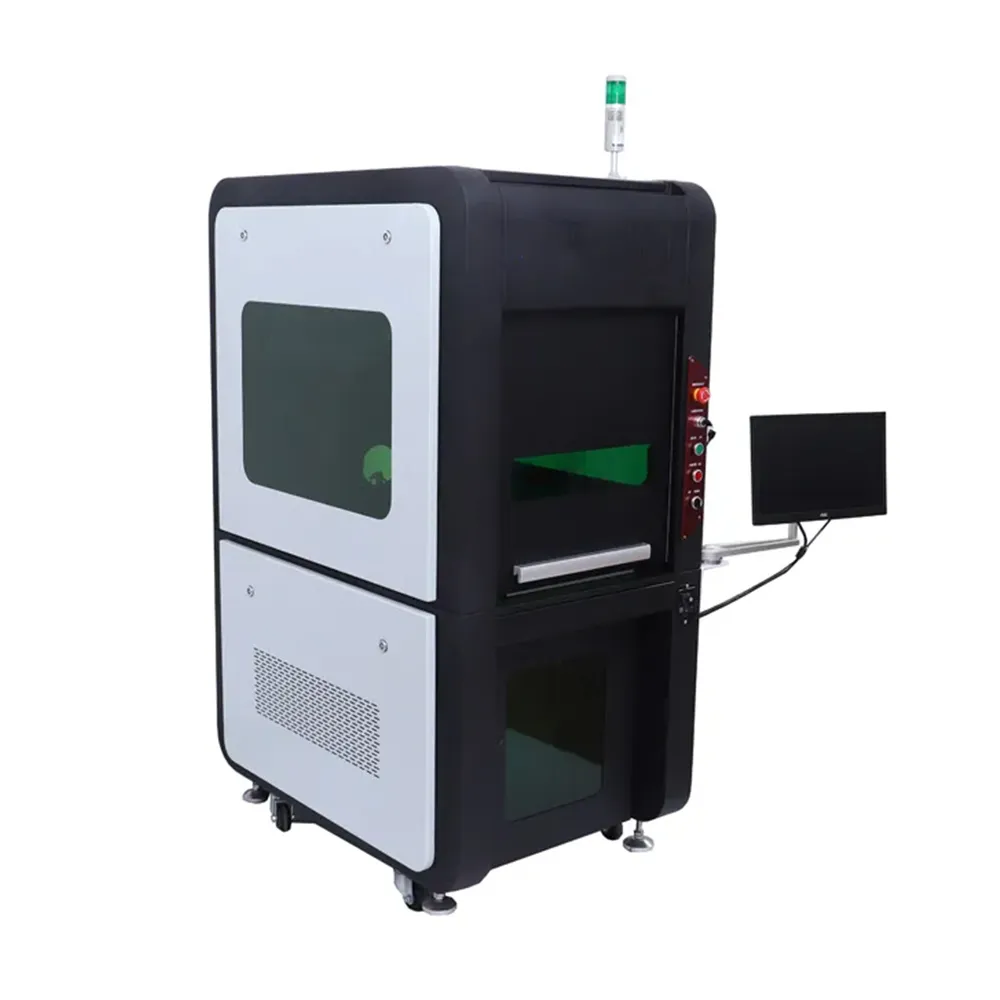
Enclosures, door interlocks, and light curtains constitute the essential engineering hierarchy for Class 4 laser safety—and are explicitly required under ANSI Z136.1 and EN 60825-1. A properly designed enclosure fully contains the beam path, suppresses hazardous reflections, and isolates operators from both direct and scattered radiation. Integrated interlocks on all access points must immediately terminate lasing upon door opening—without delay or bypass capability. Light curtains establish a dynamic safeguard zone around the work area; any intrusion triggers instantaneous beam shutdown, independent of human response time. Unlike administrative controls or PPE, these features operate reliably across shifts and require no behavioral compliance. Retrofitting legacy systems with robust, redundant interlock circuits and certified light curtains is often impractical—modern laser marking machines must embed these controls as foundational design elements. Their presence directly supports regulatory compliance, reduces incident liability, and sustains uninterrupted production.
Confirm Robust Fume Extraction and Environmental Protection
Material-Driven Air Contaminants (e.g., PVC Chlorine Gas, Metal Oxides) and Required Extraction Specifications
Laser marking generates airborne contaminants whose toxicity depends entirely on substrate chemistry. Engraving PVC releases hydrogen chloride gas—a corrosive irritant that damages respiratory tissue and equipment. Marking stainless steel produces respirable hexavalent chromium and nickel oxide particulates, both OSHA-regulated carcinogens. Even common polymers like ABS or polycarbonate can yield benzene, formaldehyde, or cyanide compounds under laser irradiation.
A compliant extraction system must meet COSHH LEV guidance: capturing fumes at the source with a minimum face velocity of 0.55 m/s. Filtration requires a staged approach—starting with a pre-filter for coarse debris, followed by a HEPA filter (99.97% efficiency at 0.3 µm), and concluding with activated carbon to adsorb VOCs and acidic gases. System performance must consistently maintain airborne contaminant concentrations below OSHA PELs and ACGIH TLVs, verified through periodic air sampling. Under-specifying extraction compromises operator health, accelerates optics degradation, and exposes facilities to enforcement action. There is no safe “partial” solution: full-source capture and multi-stage filtration are non-negotiable for industrial laser operations.
Validate Regulatory Compliance and Documentation Integrity
When purchasing a laser marking machine, verifying regulatory compliance and documentation integrity is essential—not just for legal adherence, but for operational safety and audit readiness. All industrial lasers sold in the U.S. must comply with FDA/CDRH requirements (21 CFR 1040.10 and 1040.11), while EU-market devices require conformity with EN 60825-1 and the Machinery Directive. A compliant system includes a manufacturer-issued Declaration of Conformity, a complete technical file, and a user manual detailing safety functions, maintenance intervals, and PPE specifications.
Robust documentation extends beyond compliance—it enables validation. Installation Qualification (IQ), Operational Qualification (OQ), and Performance Qualification (PQ) protocols confirm that the equipment is installed correctly, operates within defined parameters, and delivers consistent marking results under real-world conditions. Data integrity practices ensure these records remain version-controlled, attributable, legible, contemporaneous, original, accurate, complete, consistent, enduring, and available (ALCOA+ principles). Final acceptance should include signed LSO verification, maintenance logs, and a certificate of compliance issued directly by the manufacturer. Without this documented foundation, facilities risk regulatory citations, production delays due to re-validation, and unmitigated exposure to preventable laser and chemical hazards. Always review and approve the full documentation package before commissioning.
FAQ
What is a Class 4 laser, and why is it common in industrial laser marking?
A Class 4 laser represents the highest hazard level and is used in industrial marking because it allows high-speed, permanent marking on hard materials like metals and ceramics. This class is inherently hazardous due to the optical power levels required for such applications.
What are the primary concerns with different types of lasers—CO₂, fiber, and UV?
CO₂ lasers primarily pose a risk to the cornea, fiber lasers can severely damage the retina, and UV lasers carry risks like photochemical damage and toxic fume production depending on the substrate.
Why are enclosures and interlocks essential for laser marking systems?
Enclosures and interlocks are critical safety features that contain laser beam paths, suppress reflections, and prevent accidental exposure, complying with regulatory standards like ANSI Z136.1.
What kind of fumes are generated during laser marking?
Fumes depend on the substrate being marked; for example, PVC can release hydrogen chloride gas, metals can produce particulates like hexavalent chromium, and some plastics may emit carcinogenic byproducts.
How do you ensure a laser marking machine complies with safety standards?
Compliance is verified through documentation like a Declaration of Conformity, technical files, and adherence to FDA/CDRH, EN 60825-1, and Machinery Directive regulations. Full validation through IQ, OQ, and PQ helps maintain operational safety.
Table of Contents
- Assess Laser Class and Material-Specific Hazards
- Evaluate Built-in Safety Engineering Controls
- Confirm Robust Fume Extraction and Environmental Protection
- Validate Regulatory Compliance and Documentation Integrity
-
FAQ
- What is a Class 4 laser, and why is it common in industrial laser marking?
- What are the primary concerns with different types of lasers—CO₂, fiber, and UV?
- Why are enclosures and interlocks essential for laser marking systems?
- What kind of fumes are generated during laser marking?
- How do you ensure a laser marking machine complies with safety standards?