 ×
Oct 16,2026
TIANYU Laser · 30-Day Laser Cleaning Series · No. 09 · 10 min read
#LaserCleaning#CostPerPart#WeldCleaning#ComplexGeometry#TIANYULaser
Most laser cleaning demos are run on flat plate. It is the easiest possible geometry: constant standoff, no shadowing, no re-orientation, one pass. That demo tells you the machine works. It tells you nothing about what the machine will cost you on the parts you actually make.
Real parts are curved, welded, threaded, drilled, stamped and boxed-in. Every one of those features forces the operator to do something the flat plate never required: re-position, re-focus, slow down, or hand-finish. That is where the labor minutes — and therefore the money — goes.
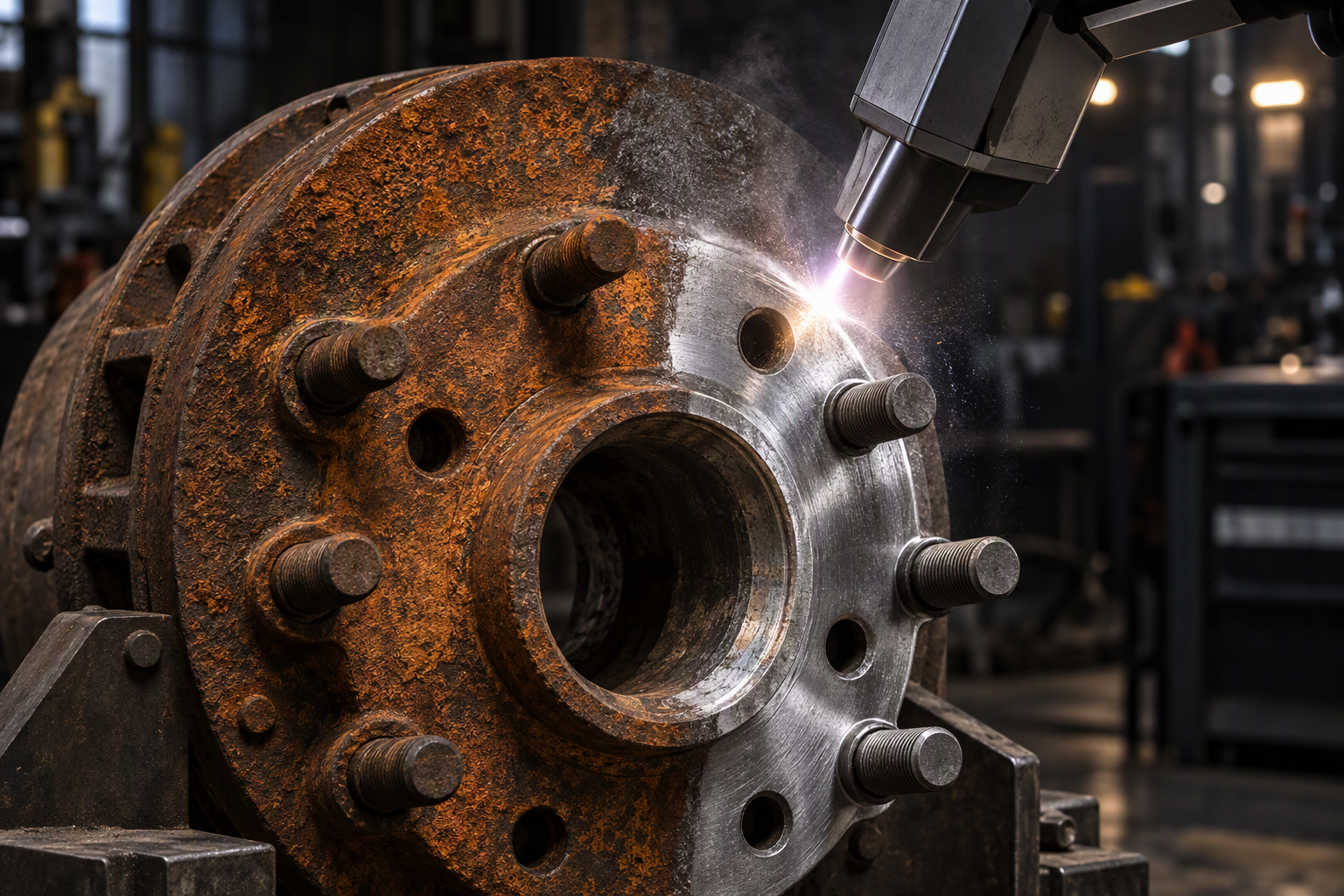
▴ The easy 10% of a cleaning job is the flat face. The expensive 90% is every curve, seam and thread around it.
Nearly every cost surprise on complex parts comes from one of three features. Learn to spot them on a drawing and you can predict the cleaning cost before you quote the job.
| Feature | Why it is slow / expensive | What a laser actually does | What fixes it |
|---|---|---|---|
|
Curved surfaces pipe, tube, shaft, pressed shell |
Focal point drifts as the head follows the curve; power density collapses off-focus, so the operator slows down or re-passes | Cleans perfectly — but only if standoff stays inside the depth of focus | Standoff roller guide, defocused wide beam, or a robot / turntable holding constant distance |
|
Weld seams & HAZ post-weld oxide, discolouration, spatter |
Manual wire-brushing or grinding is slow, noisy, and eats discs; the toe of the weld is hard to reach without gouging the parent metal | Removes oxide and spatter in one pass without touching the weld profile | Correct pulse width (short pulses for oxide, longer for spatter) + line scan; 0.5–2.0 m/min typical |
|
Threads & blind holes tapped holes, internal bores, slots |
Shadowing: the beam travels in a straight line and simply cannot see around a corner or into a deep bore | Partial — only the surfaces the beam can reach at a workable angle | Defocused beam + angled passes for shallow threads; deep internal bores still need a brush or a rotary lance |
Read the third row twice. Threads are the single most over-promised feature in laser cleaning sales decks. A laser will clean the flanks and crests of a thread it can see. It will not clean the bottom of a 40 mm blind hole, and no amount of wattage changes that.
Below is a like-for-like comparison on three typical parts, using a fully loaded labour rate of $38/hour (wage + overhead) and typical consumable prices. These are illustrative shop-floor figures — your numbers will differ — but the ratios are what matter.
| Part & feature | Manual (grind / brush) | Chemical (pickle / paste) | Laser (500 W pulsed) |
|---|---|---|---|
|
A. Flat plate 300×200 mm, light rust |
3.5 min → $2.20 + disc $0.60 = $2.80 |
bath + rinse + disposal $2.66 |
0.4 min → $0.25 + power $0.03 = $0.28 |
|
B. Pipe weld joint DN80, ~1.2 m of seam |
9 min → $5.70 + 2 discs $1.40 = $7.10 |
paste $2.20 + neutralise & rinse 3 min = $4.10 |
1.5 min → $0.95 + power $0.04 = $0.99 |
|
C. Threaded fitting M20, rust in 8 threads |
2.5 min → $1.58 + brush $0.30 = $1.88 |
$0.70 + rinse/dry 1.5 min = $1.65 |
0.7 min → $0.44 + power $0.02 = $0.46 |
Take a shop cleaning 12,000 mixed parts per year — a realistic blend of plates, welds and fittings, average manual cost $3.40/part. Here is the year, in numbers.
Two things to notice. First, the saving is driven almost entirely by minutes per part, not by machine price — which is why the geometry of your parts matters more than the spec sheet. Second, this is a recurring saving: it repeats every year the machine runs.
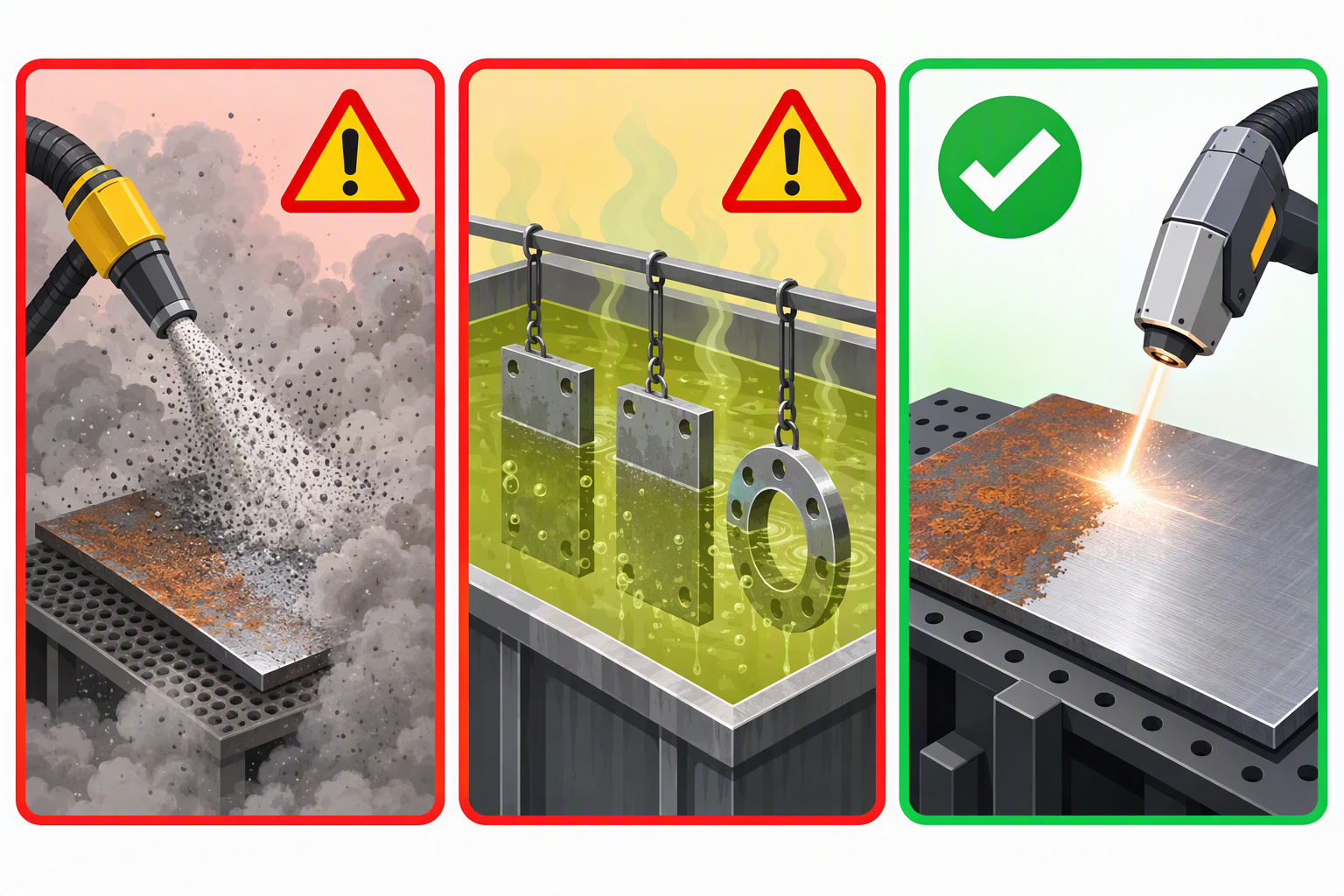
▴ Every method cleans metal. Only one of them has no media, no acid and no waste stream — and that is what shows up in the ledger.
Before you quote a complex-part job, check these four. If any one of them fails, the cost advantage shrinks fast.
| Number | Typical value (500 W pulsed) | Why it decides the cost |
|---|---|---|
| Depth of focus | ±3–5 mm at 200 mm F.L. | Outside this window power density drops ~20%+ and the operator must slow down or re-pass — this is the #1 hidden cost on curved parts |
| Scan width | 10–80 mm adjustable | Doubling scan width roughly halves the passes on a wide weld; on thin seams a wide beam wastes energy and risks the parent metal |
| Reach / access angle | ~30° minimum to surface | Below this angle the effective fluence collapses; recessed and internal features quickly become uneconomic |
| Part handling | handheld vs turntable vs robot | On high-volume complex parts, the robot or turntable often pays for itself faster than a bigger laser — it removes the re-orientation minutes |
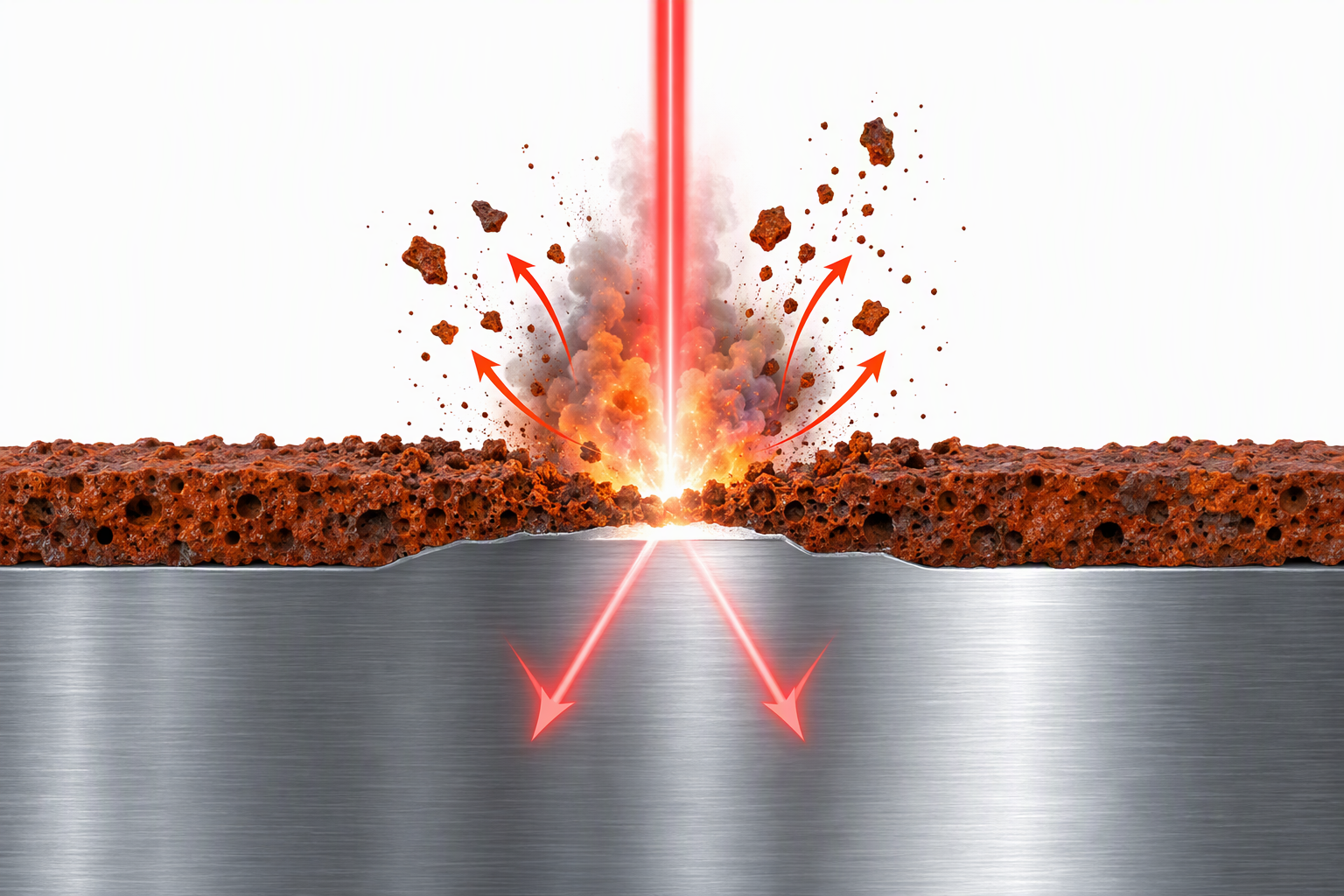
▴ 1064 nm light is absorbed by oxide and contaminant, reflected by clean metal — that selectivity is why the beam can clean a weld toe without gouging it.
1. Deep internal bores and blind holes. If the feature is more than about 1.5× its diameter deep, the beam cannot reach the far wall at a usable angle. A rotary brush or a chemical dip is cheaper and faster.
2. Very heavy, deeply pitted corrosion in crevices. Where rust has eaten 0.5 mm+ into a crevice, laser will remove the loose oxide but you will still need mechanical prep to reach the pit bottoms. Laser plus a light grind beats laser alone.
3. Low-volume, one-off, flat work. If you clean ten flat plates a month, a $10,000 machine does not pay back in any reasonable horizon. Laser is a volume and geometry play, not a universal upgrade.
Step 1 — Classify your parts. Group them into flat / curved / welded / threaded. Cost them separately; do not average a flat plate with a pipe joint.
Step 2 — Time one real part, not a demo part. Clock an operator on your worst geometry, with the re-orientation and re-focus included. That number is the only one that matters.
Step 3 — Count the consumables you stop buying. Discs, media, acid, rinse water, disposal fees, PPE. Most buyers forget this column, and it is often the largest one.
Step 4 — Match the machine to the geometry, not the budget. Curved and welded work usually needs the adjustable scan width and a turntable or robot, not more watts. Buying 2 000 W to fix a standoff problem is money spent in the wrong place.
▴ TIANYU 500 W portable pulsed cleaner — 1064 nm, adjustable pulse width, 10–80 mm scan width, roller standoff guide for curved work. 100–6 000 W range, handheld / benchtop / robotic. CE certified.
👉 Send us your three hardest parts — we’ll send back a cost-per-part estimate
Tell us the material, the contaminant, the geometry and your monthly volume. We reply with recommended settings, the right form factor, and a cost-per-part estimate — within 24 hours.
About Wuhan TIANYU Laser
Wuhan Maohe Tianyu Laser Equipment Co., Ltd. — 100 W to 6 000 W portable, benchtop and robotic laser cleaning & welding systems.
CE certified. Exporting to Europe, Southeast Asia and the Middle East.
OEM / ODM available for housing, power and scan width.
Part 09 of the "30 Laser Cleaning Questions" series.
Next → "What Does a Laser Cleaning Machine Really Cost? The Truth Behind the $1,200–$42,000 Gap"
Follow us — one practical insight every day.

 EN