 ×
Oct 15,2026
TIANYU Laser · 30-Day Laser Cleaning Series · No. 08 · 9 min read
#LaserCleaning#FlashRust#CorrosionControl#SurfacePrep#TIANYULaser
Laser ablation removes the oxide and leaves bare metal with no passive layer and very high surface energy. That is exactly what makes a cleaned part weld-ready and paint-ready — and it is also why the surface is chemically hungry. Within minutes a native oxide begins to regrow (roughly 1–3 nm in the first hour). Within hours, if there is moisture and no protection, that film thickens into visible flash rust.
Nothing you do later undoes the difference between coating a part at minute 10 and coating it at hour 16. The surface does not wait for you.
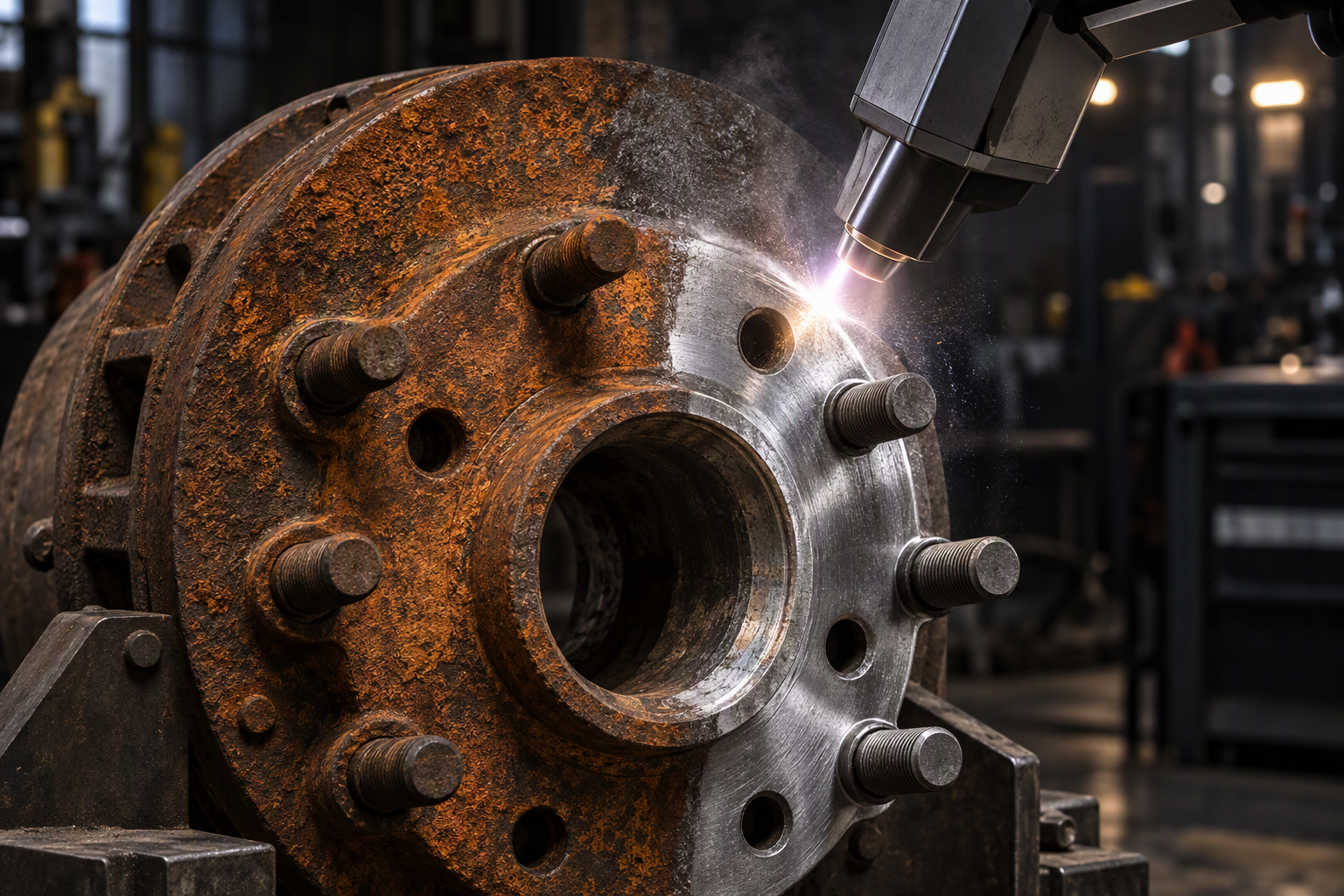
▴ The “after” shot is the easy part. What happens in the next 30 minutes decides whether it still looks like this next month.
Corrosion needs three things: bare metal, an electrolyte film, and time. You create the first one on purpose. The other two are the ones you control — and most shops never think about them.
| Factor | Why it matters | Threshold that changes everything | Effect on re-rust |
|---|---|---|---|
| Relative humidity | Below a critical RH there is no continuous water film to carry the corrosion current | <40% low 40–60% moderate >60% critical |
Carbon steel barely corrodes below ~60% RH; above it the rate climbs steeply |
| Temperature | Every reaction speeds up with heat | +10 °C ≈ 2× rate | Warm and humid is the worst combination for a bare part |
| Chlorides (salt) | Salt breaks down the passive film and holds moisture | >1 g/m² = high risk | Coastal air, de-icing salt, and sweaty hands all seed pitting |
| Time since cleaning | Oxide regrowth is continuous | minutes → hours | The single biggest lever you own — and the one nobody watches |
Read that table as a warning, not a description. Three of the four rows are set by the room you clean in. If your workshop sits at 70% RH in summer, you are working against the clock on every single part.
| # | The mistake | What it actually does | How fast you see it | Do this instead |
|---|---|---|---|---|
| 1 | “It’s indoors, it’ll be fine” | Leaves the activated surface with no protection at all | 4–12 h at 50% RH | Coat or weld in the same shift; never leave a bare part overnight |
| 2 | Rinsing with water, or letting it air-dry | Leaves a water film, dissolved salts and a fresh electrolyte layer | minutes | Never wet-clean carbon steel; if you must, dry with hot dry air immediately |
| 3 | Blowing off with unfiltered compressed air | Sprays oil and water aerosol straight onto bare metal | instant seed | Use dried, filtered air — or a dry brush / vacuum |
| 4 | Handling with bare hands | Sweat is chloride and salt; fingerprints become rust spots | hours at contact points | Nitrile gloves, always — and never touch the cleaned face |
| 5 | Cleaning more than you can protect | The last parts sit bare for days while you work through the pile | 1–3 days | Clean in batches you can coat in one shift — not the whole plant on Friday |
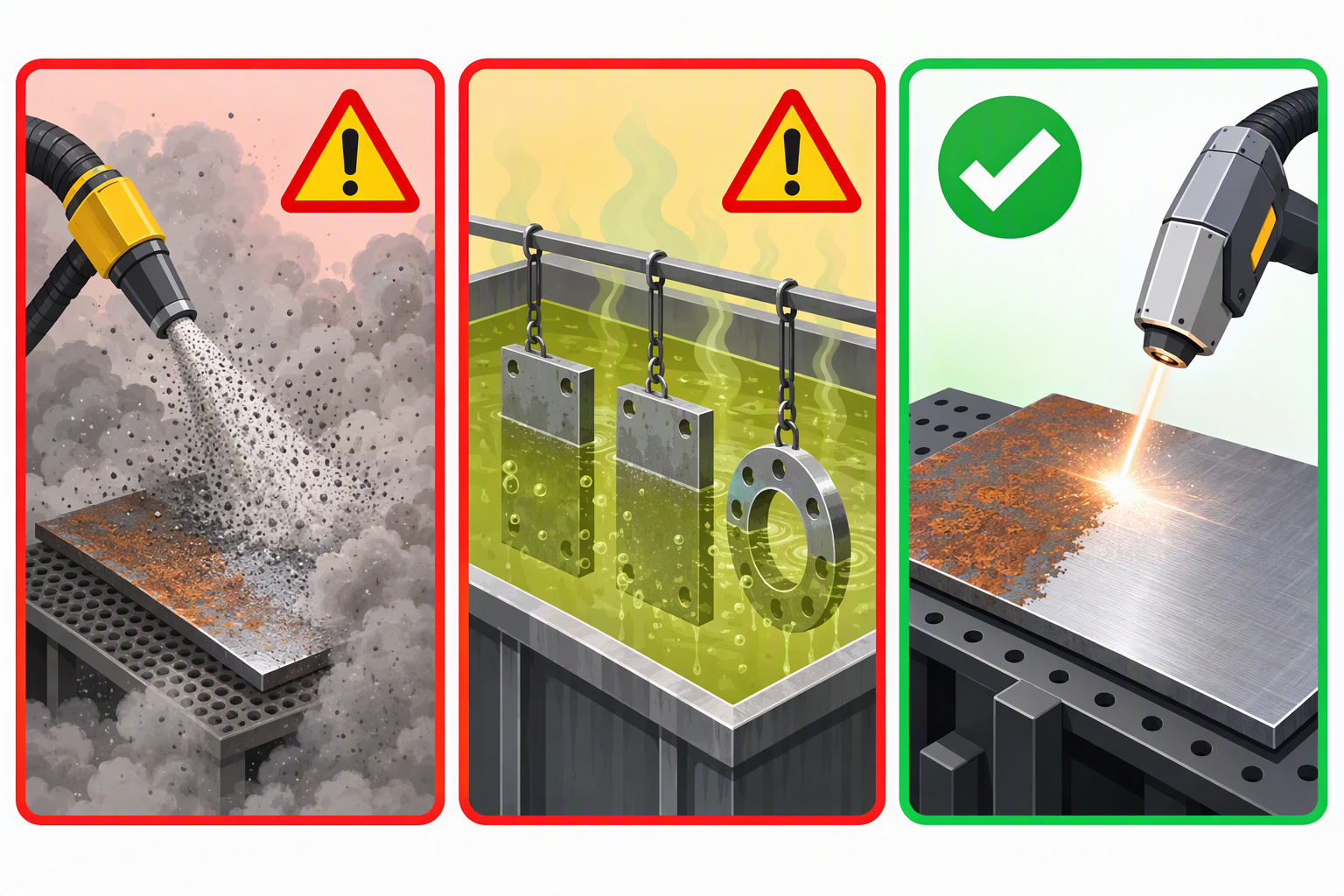
▴ Every method leaves bare, activated metal. Laser is the cleanest — which is precisely why it is the most demanding about what you do next.
These are typical times to visible flash rust on freshly ablated carbon steel, indoors, with no protection. Use them as a planning tool, not a guarantee — but note how wide the spread is.
That spread — from three days to five minutes — is why the same machine gets blamed in one shop and praised in another. It is rarely the laser. It is the room.
“We’ll protect it later” is not a plan. Protection is a decision with a deadline, and the coating you choose sets how long the part stays clean. Times below are typical salt-spray (ASTM B117) endurance — the neutral, comparable number.
| Protection | Applied after cleaning | Indoor life | Salt-spray (ASTM B117) | Notes |
|---|---|---|---|---|
| None (bare) | — | hours | < 2 h | Acceptable only if you weld or coat within the hour |
| Dry-film rust preventive oil | immediately | 2–6 weeks | 24–72 h | Thin, cheap, easy to remove before painting |
| Wax / lanolin film | immediately | 3–12 months | 200–500 h | Best for storage and sea transport |
| Zinc-rich primer | < 30 min | 6–18 months | 300–600 h | The standard for structural steel |
| Epoxy + polyurethane topcoat | < 30 min | 5–15 years | 1 000–1 500 h | The full system — the real answer for exposed parts |
On stainless the failure does not look orange, so people miss it. The problem is free-iron contamination: a carbon-steel brush, a contaminated cleaning head or airborne grinding dust leaves microscopic iron on the surface. Days later you get pinpoint rust spots that look like the steel itself failed — and the customer blames the material.
The fix is procedural, not optical: never use a carbon-steel brush on stainless, keep stainless tooling separate, and passivate (citric or nitric acid) after cleaning to dissolve the free iron and rebuild the passive film.
Step 1 — Clean and coat in the same shift. Set one hard rule: nothing gets cleaned unless its protection is on the bench. This single rule removes most flash-rust complaints.
Step 2 — Dry, do not rinse. Hot dry air or a dry cloth. A water rinse on carbon steel is a step backwards, no matter how clean the water looks.
Step 3 — Coat inside the 30-minute window. If you cannot protect the part within the window, do not clean it yet. Clean it when you are ready to finish it.
Step 4 — Log it. Date, ambient RH, coating used. If a part re-rusts, the log tells you in seconds whether it was the environment or the process — instead of guessing and blaming the machine.
▴ TIANYU 500 W portable pulsed cleaner — 1064 nm, adjustable pulse width, 10–80 mm scan width. Cleans to bare metal in one pass; the protection plan is up to you. CE certified, 100–6 000 W range available.
👉 Send us your part, material and storage conditions — we’ll send back the right protection window
Tell us the metal, the contaminant and where the part lives afterwards (indoor / coastal / outdoor). We reply with the recommended cleaning settings plus a protection window and coating plan — within 24 hours.
About Wuhan TIANYU Laser
Wuhan Maohe Tianyu Laser Equipment Co., Ltd. — 100 W to 6 000 W portable, benchtop and robotic laser cleaning & welding systems.
CE certified. Exporting to Europe, Southeast Asia and the Middle East.
OEM / ODM available for housing, power and scan width.
Part 08 of the "30 Laser Cleaning Questions" series.
Next → "Curved Surfaces, Welds & Threads: How It Really Performs on Complex Parts"
Follow us — one practical insight every day.

 EN