
 EN
EN


Material-Specific Thickness Limits for a 3000W Laser Cutting Machine
Carbon Steel: Achieving Clean Cuts Up to 25 mm
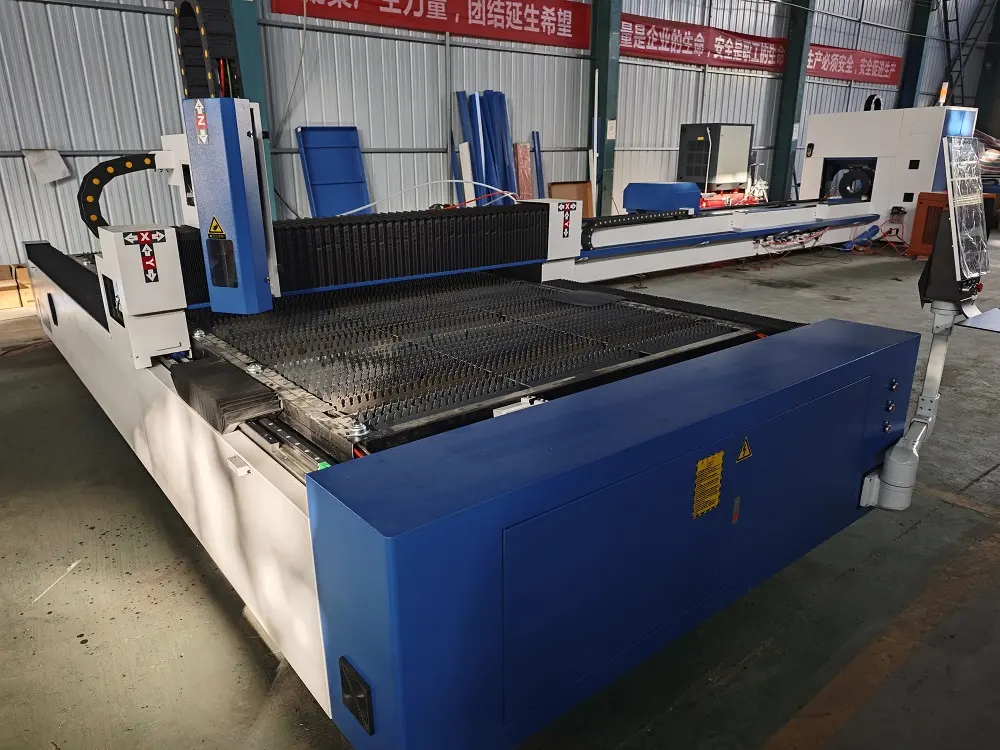
Carbon steel delivers optimal performance with a 3000W laser cutting machine, cleanly processing sheets up to 25 mm thick. Oxygen assist gas enables efficient piercing and slag-free edges at this maximum thickness, though cutting speeds drop significantly beyond 18 mm. For structural components requiring precision, this capacity balances productivity and quality across industrial applications.
Stainless Steel and Aluminum: Balancing Speed, Edge Quality, and Thermal Conductivity
Stainless steel cuts cleanly up to 10 mm with nitrogen assist gas—preventing edge oxidation but requiring slower speeds above 6 mm. Aluminum’s high thermal conductivity limits usable thickness to 8 mm, even at full power. Both materials demand precise focal positioning to mitigate heat distortion; thicker sections risk dross formation and reduced cut accuracy in high-tolerance projects.
Copper and Brass: Reflectivity Challenges That Cap Usable Thickness at 6 mm
Copper and brass absorb infrared laser energy poorly—reflecting over 90%—which constrains their usable thickness to 6 mm on a 3000W system. This necessitates specialized anti-reflection coatings and reduced cutting speeds. Even at sub-4 mm thicknesses, operators must fine-tune nozzle distance and gas pressure to achieve burr-free edges in electronics or decorative applications.
Beyond Wattage: Key Technical Factors That Determine Actual Cutting Performance
Beam Quality (BPP) and Focus Spot Size — Why Not All 3000W Laser Cutting Machines Perform Equally
Beam Parameter Product (BPP) fundamentally governs cutting precision in 3000W laser systems. A lower BPP value (≤2.0 mm·mrad) enables tighter focus spots—under 0.1 mm diameter—concentrating energy density beyond 10⁷ W/cm². This allows cleaner piercing and narrower kerfs in 20 mm carbon steel compared to high-BPP systems. Crucially, spot size dictates melt efficiency: smaller diameters vaporize material faster while reducing heat-affected zones. However, optical component degradation over time increases BPP; machines using premium collimators maintain <5% power divergence at 5 m focal lengths—explaining why identically rated 3000W systems can exhibit 15–30% speed variations on identical stainless steel sheets.
The Nonlinear Relationship Between Laser Power and Maximum Thickness
Power alone can’t overcome material physics. Doubling from 1500W to 3000W increases maximum carbon steel capacity by just 40% (18 mm to 25 mm)—not 100%—due to thermal saturation. Beyond 15 mm, conductive heat loss accelerates, requiring 30% longer dwell times per millimeter. At 25 mm, oxygen-assisted cutting demands 2.5× higher gas pressure than at 10 mm to eject molten material, yet edge roughness increases exponentially. This diminishing return stems from the cube-square law: material volume grows faster than the laser’s penetration area. Consequently, 4000W systems only achieve 28–30 mm cuts—demonstrating why process optimization matters more than raw wattage beyond critical thresholds.
Process Optimization: How Gas, Nozzle, and Motion Control Maximize a 3000W Laser Cutting Machine’s Capability
Oxygen vs. Nitrogen Assist Gases: Trade-offs in Speed, Edge Oxidation, and Thickness Capacity
Reasonable assist gas selection fully unlocks comprehensive processing potential of the 3000W laser cutting machine. Oxygen triggers exothermic chemical reactions to boost cutting velocity of the laser cutting machine, perfectly fitting thick carbon steel processing over 15 mm, though finished edges come with oxidation traces needing secondary polishing. Nitrogen gas isolates air contact and discharges molten metal inertly, delivering oxide-free clean cuts on the laser cutting machine. Stainless steel and aluminum processing rely heavily on nitrogen supply maintained above 20 bar pressure to offset strong thermal conductivity. Distinct functional differences exist between two gas options: oxygen expands applicable cutting thickness of the laser cutting machine by 30%, while nitrogen prioritizes flawless edge finish for thin conductive metal fabrication.
FAQs
Q: What is the maximum thickness carbon steel can be cut with a 3000W laser?
A: Carbon steel can be cut cleanly up to 25 mm using a 3000W laser cutting machine, although cutting speeds drop significantly beyond 18 mm.
Q: What gases are best for cutting stainless steel and why?
A: Nitrogen assist gas is recommended for cutting stainless steel as it prevents edge oxidation, maintaining clean, oxide-free edges.
Q: Why is copper challenging to cut with a 3000W laser?
A: Copper reflects over 90% of infrared laser energy, making it difficult to cut without specialized anti-reflection coatings and precise adjustments.
Q: Does higher wattage always mean better cutting performance?
A: Not necessarily. Beyond certain thresholds, higher wattage faces diminishing returns due to factors like thermal saturation and conductive heat loss.
Q: How can gas selection impact cutting quality and speed?
A: Oxygen enables faster cutting speeds but leaves oxidized edges, while nitrogen offers slower cutting with clean, oxide-free finishes.
Ready to Optimize Metal Fabrication with Reliable 3000W Laser Cutting Machine?
Laser cutting machine acts as core production hardware determining fabrication efficiency and finished product quality for metal processing enterprises. No medium and heavy metal cutting project can achieve ideal dimensional accuracy, edge smoothness and delivery efficiency without properly matched 3000W laser cutting machine. Choose professional OEM laser cutting machine manufacturer with solid industrial manufacturing experience and mature parameter tuning technology. We supply stable-performance laser cutting machine adaptable to carbon steel, stainless steel, aluminum, copper and brass processing, supporting customized configuration of beam quality, assist gas system and motion control module. Whether you engage in structural part manufacturing, hardware accessory processing or customized metal artwork production, we deliver cost-effective laser cutting machine solutions compliant with international industrial standards. Reach out to us immediately for free no-obligation technical consultation, and select qualified laser cutting machine to elevate your overall production competitiveness.