 ×
Nov 19,2026
A rail car body carries roughly 1,200 metres of aluminium weld. Every metre of it has to be white before paint. This is the before-and-after, with the grade, the parameters and the cost per metre.
| Metric | Pickling | Laser 300 W | Change |
|---|---|---|---|
| Time per body | 6.0 h | 1.0 h | −83% |
| Operators | 3 | 1 | −2 |
| Consumables per body | $310 (acid, neutraliser) | $14 (power, window) | −$296 |
| Wastewater | 4.2 m³ | 0 | −100% |
| Rejection rate | 2.8% | 0.4% | −2.4 pts |
| Cost per metre | $1.86 | $0.31 | −83% |
Table 1 — Same car body, same weld set, measured over 20 bodies. Labour at $26/h loaded; rejection valued at $4,200 per body.
Rail customers do not accept "it looks clean". They accept a colour grade. The reference is a weld tint chart — grade 1 is barely visible straw, grade 4 is heavy blue-black — and the acceptance criterion for painted 6xxx bodies is typically grade 2 or better.
| Grade | Appearance | Cause | Accepted? |
|---|---|---|---|
| 1 | Faint straw | Low heat input, good shielding | Yes |
| 2 | Light brown / purple | Normal TIG/MIG pass | Yes — the working target |
| 3 | Blue / dark brown | High heat, poor shielding | Only if cleaned to grade 2 |
| 4 | Black / heavy oxide | Contamination, gas failure | No — and it hides porosity |
Table 2 — Weld tint grades. The laser's job is to take grade 3 down to grade 1–2 without removing parent metal; it cannot fix a grade 4 weld, because the oxide is thicker than the cleaning depth.
| Parameter | Setting | Effect if wrong |
|---|---|---|
| Power | 250–320 W | Below 200 W: oxide remains in the grain boundaries |
| Beam | Line, 30–40 mm | Round spot triples the passes and the labour |
| Scan speed | 2,500–3,500 mm/s | Too slow: melts the weld toe |
| Overlap | 30% | Below 20%: tiger stripes that fail the visual |
| Standoff | 180–220 mm | Closer: pitting at the toe; further: no cleaning |
| Assist gas | Compressed air, 0.3 MPa | None: plume deposits soot back on the seam |
Table 3 — Working parameters for 6xxx aluminium with a 300 W line-beam head. These are the numbers our rail customers run; every one of them is a ceiling or a floor, not a suggestion.
The $0.31 in Table 1 breaks down as: electricity $0.04, window amortisation $0.03, machine amortisation $0.19 (5 years, 1,800 bodies), and labour $0.05 at 1 hour per body. The pickling figure is dominated by labour and acid, not by the process itself.
| Line item | Pickling /m | Laser /m |
|---|---|---|
| Labour | $0.98 | $0.05 |
| Consumables | $0.78 | $0.07 |
| Waste / disposal | $0.10 | $0.00 |
| Machine amortisation | $0.00 | $0.19 |
| Total | $1.86 | $0.31 |
Table 4 — Cost per metre, itemised. The pickling line was already paid for, which is why its amortisation is zero and its labour is not.
The number is not a guess. A typical 22 m aluminium car body has roughly 380 m of longitudinal weld, 420 m of cross-member and frame weld, 260 m of roof-to-side seam, and 140 m of small fitment welds. Every metre of it has to be visually clean before primer, because paint over heat tint fails adhesion at the seam within two years.
The split matters for planning, because the four groups clean at different rates. Long straight seams run at the full 3 s/m with a line beam. Small fitment welds — brackets, earth studs, cable clips — take longer per metre because the operator spends more time positioning than cleaning, and a realistic average for those is 8 s/m. Blending the two gives the 1.0 hour per body in Table 1.
| Weld group | Length | Rate | Time |
|---|---|---|---|
| Longitudinal seams | 380 m | 3 s/m | 19 min |
| Cross-member / frame | 420 m | 3.5 s/m | 24.5 min |
| Roof-to-side | 260 m | 3 s/m | 13 min |
| Small fitments | 140 m | 8 s/m | 18.7 min |
| Total | 1,200 m | — | 75 min |
Table 5 — Weld mix per body. The small fitments are 12% of the length and 25% of the time, which is why quoting a single s/m figure to a customer is misleading.
Two operational notes from the line. The operator cleans in the same sequence the welders worked, so a body never has to be turned twice — sequence discipline saves more time than scan speed. And the laser runs from the same 400 V supply as the welding sets, so no new distribution board was needed; that alone removed a $6,000 electrical quote from the project.
Acceptance is sampled, not 100%. The customer inspects the first body of each shift fully, then 20% of seams at random against the tint chart, plus every seam flagged by the welder. Over 14 months that sampling plan caught two process drifts — both caused by a dirty window raising the effective spot size, both fixed in twenty minutes. Without it, those two drifts would have shipped as paint adhesion failures six months later, which is the expensive way to find out.
Two things, and buyers discover both in the first week. Laser cleaning removes the tint but not the porosity underneath it — a grade 4 seam that is cleaned will look perfect and fail ultrasonic testing. And it does not replace pre-weld cleaning: the oxide on the faying surface has to go before welding, not after, or the porosity is already in the metal.
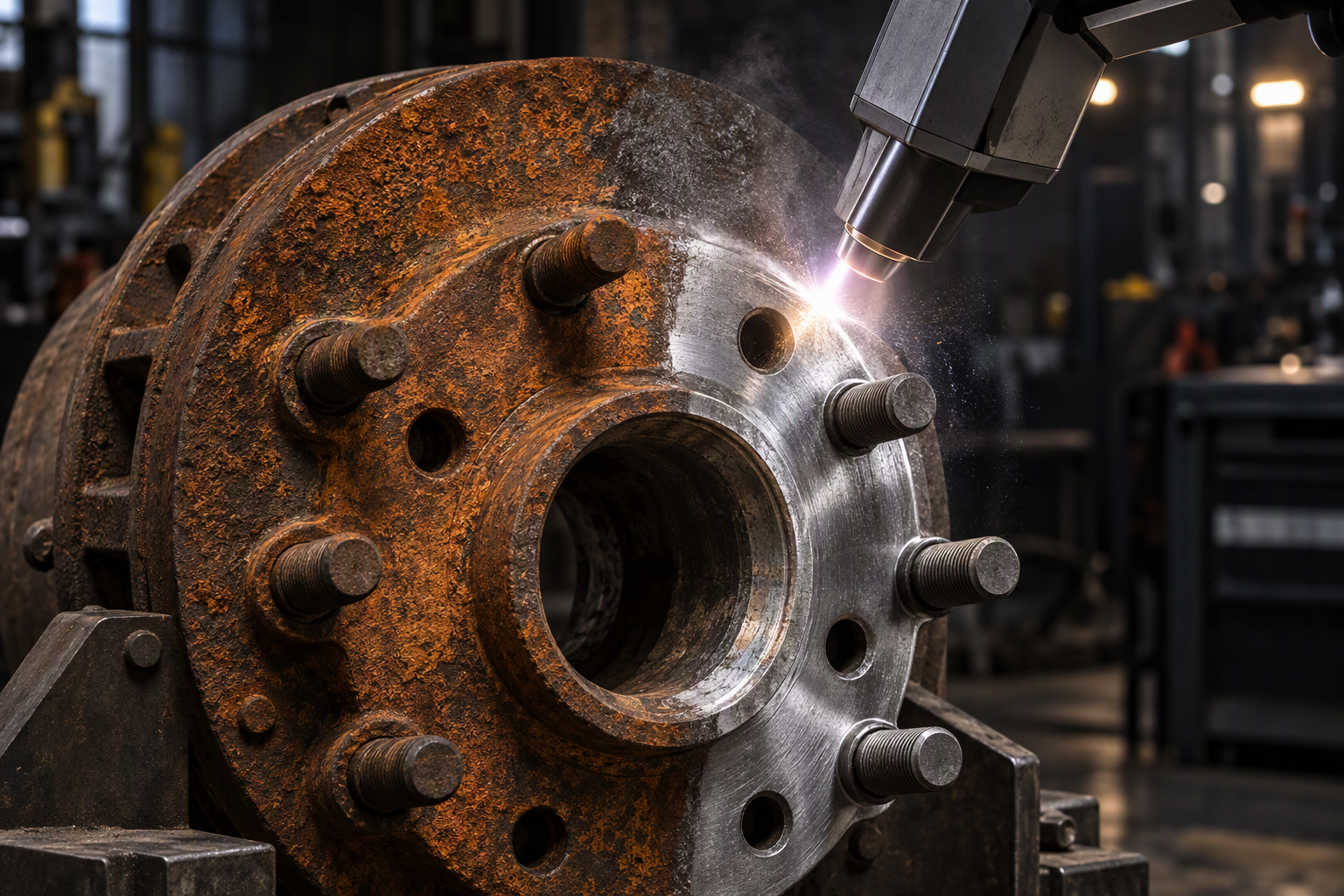
1,200 m per body, 3 seconds per metre, 1 hour instead of 6, $0.31 instead of $1.86, and no wastewater. Grade 2 or better, verified against a tint chart, not against opinion.
It removes tint, not porosity. Clean the faying surface before welding, clean the tint after, and this is the most reliable laser application in rail.

 EN