What Can't It Remove?4 Cases Where You're Wasting Money
TIANYU Laser · 30-Day Laser Cleaning Series · No. 06 · 8 min read
#LaserCleaning#BuyersGuide#RustRemoval#ShopFloor#TIANYULaser
The email landed on a Tuesday and it was not f...
What Can't It Remove?
4 Cases Where You're Wasting Money
TIANYU Laser · 30-Day Laser Cleaning Series · No. 06 · 8 min read
#LaserCleaning#BuyersGuide#RustRemoval#ShopFloor#TIANYULaser
The email landed on a Tuesday and it was not friendly.
“We bought a 500 W cleaner eight months ago. On rust it is magic. But it failed on four of our jobs — a grease tank, a set of oil-soaked castings, some 2 mm epoxy plates and an acrylic guard. Did we buy the wrong machine?”
Short answer: no. Long answer: nobody sold him a machine that does everything, because no such machine exists. What follows is the actual reply — four questions, four honest answers, and the four situations where a laser cleaner will quietly cost you money.
The one rule that decides everything
Before the questions, one paragraph of physics, because every answer below comes from it.
A 1064 nm nanosecond pulse only removes something if the material absorbs the beam better than what is underneath it, and only if the contamination is thin enough for the pulse to reach through. Rust, paint, oil film and mill scale pass both tests. Thick soft deposits, deep-soaked contamination, very thick coatings and transparent materials fail one or both — and when they fail, the laser does not just work slowly. It does nothing useful while you hold the trigger.
▴ Where the beam works: a dark, thin, absorbing layer over a reflective metal. Remove any one of those three conditions and the physics stops working for you.
CASE 1 — THICK SOFT DEPOSITS We tried it on a tank with about 12 mm of old grease and sludge. It just drew a shiny line and left the rest. Why? Because a laser is an ablation tool, not a bulk-removal tool. A 500 W nanosecond pulse vaporises a film measured in microns — on dried hydrocarbon sludge that is roughly 0.05–0.1 mm per pass. Twelve millimetres of sludge is therefore 120+ passes over the same spot, and by pass five you are heating a puddle, not cleaning a surface. Compare that with the same head on a thin film: a 20 µm oil film comes off in one pass at 2–4 m²/h. Same machine, same material, 40× the speed — the only variable is thickness. What to do: scrape, vacuum or steam the bulk off first, then laser the last 100–200 µm. That sequence is still faster and cleaner than solvent, because you are using the beam where it is actually efficient instead of where it is stubborn.
CASE 2 — CONTAMINATION SOAKED INTO THE METAL Our cast-iron housings sat in cutting oil for twenty years. The laser brought them up bright — but two days later they were oily again. What happened? The surface was clean. The inside was not. Cast iron is porous by nature — typically 5–15% void volume — and twenty years of cutting oil has soaked 0.5–3 mm into the pore network. The beam removes what it can see, which is the top few microns. The oil behind it simply wicks back out over the next 48 hours. This is the most common “the laser did not work” complaint we hear, and it is almost never the laser's fault. It is a volume problem, and a surface tool cannot solve a volume problem. What to do: run the laser with strong fume extraction and repeat after 24 hours, or bake the part at 150–200 °C first to drive the oil to the surface and then laser it off. If the part will be painted, use a coating that tolerates residual oil rather than fighting the porosity. Test it before you commit: clean one part, wait three days, wipe it with white paper. If the paper shows oil, the porosity won.
The four no-go zones, side by side
Here is the same information as a decision table. Keep it next to the machine.
| Case |
Symptom on the shop floor |
Why the beam fails |
What to use instead |
Cost of ignoring it |
Thick soft deposits
(>1 mm grease, sludge, bitumen) |
Beam draws a line, leaves the rest |
Ablation rate 0.05–0.1 mm/pass → 100+ passes |
Scrape / vacuum bulk first, laser the residue |
Operator hours burned at ~0 m²/h |
Contamination in pores
(castings, sintered parts) |
Clean today, oily again in 48 h |
Oil sits 0.5–3 mm below the surface |
Bake-out or extract-then-repeat, or oil-tolerant coating |
Repaint fails; rework on the customer's floor |
Coatings over ~1 mm
(epoxy, rubber lining, hot-dip) |
Burns, smokes, leaves a baked residue |
Upper layer shields the lower; binder scorches into steel |
Mechanical removal of bulk, laser the last 100–200 µm |
Scorched substrate → full re-blast |
Transparent non-metals
(glass, acrylic, clear PC) |
Nothing happens — and the beam exits the far side |
Glass transmits >90% at 1064 nm; acrylic ~92% |
Never laser them. Wet wipe or ultrasonic bath |
Uncontrolled beam = a real safety incident |
The fourth row is not a performance issue. It is a safety issue. If 90% of the beam passes through the workpiece, that energy is now travelling somewhere you did not plan for. Never point a laser cleaner at a transparent panel to “see what happens.”
CASE 3 — COATINGS OVER ~1 MM We have 2 mm of epoxy on steel plates. The laser burns it and leaves a residue we then have to grind off anyway. Is that normal? Yes, and it is predictable. Absorption is fine here — the problem is thickness. Single-coat paint at 30–80 µm strips at 1–2 m²/h. Multi-coat or epoxy at 100–300 µm runs at 0.4–0.8 m²/h. At 2 mm you are roughly 10× thicker again, which puts you under 0.15 m²/h — and the binder starts scorching into the steel before the lower layers are gone. What to do: strip the bulk mechanically (it is fast and cheap), then use the laser on the final 100–200 µm. That is where the beam is unbeatable — it removes the last layer without touching the base metal, which is exactly what a grinder cannot do.
CASE 4 — TRANSPARENT NON-METALS Can we clean the acrylic machine guards and glass viewports with it? No — and this is the one case where we will refuse to sell you the answer. Soda-lime glass transmits more than 90% of a 1064 nm beam; acrylic and polycarbonate are similar. There is almost nothing to absorb, so nothing heats, so nothing is removed. Meanwhile a near-full-power beam is leaving the back of the part. What to do: glass and plastic guards are a wet-wipe or ultrasonic-bath job. Keep the laser for metals and for the opaque coatings on them.
“Every honest supplier will tell you there is a list of things the machine cannot do. The dishonest ones tell you there is not — and then you find out on your own floor, on your own deadline.” — TIANYU Laser technical support
The other side of the coin: what it does brilliantly
It would be a strange article that only listed failures. Here is the same 500 W head on the jobs it was built for — the numbers are the mirror image of the table above.
2–4 m²/hOil film & light grease (1–20 µm)
1.5–3 m²/hLight surface rust
1–2 m²/hSingle-coat paint & mill scale
| Layer thickness |
Removal rate @ 500 W |
Passes needed |
Verdict |
| 1–20 µm (oil film) |
2–4 m²/h |
1 |
Sweet spot |
| 20–100 µm (light rust) |
1.5–3 m²/h |
1 |
Sweet spot |
| 30–80 µm (single coat paint) |
1–2 m²/h |
1 |
Good |
| 100–300 µm (epoxy / multi-coat) |
0.4–0.8 m²/h |
2–3 |
Patience |
| 1 mm+ (thick coating) |
<0.15 m²/h |
10+ |
Wrong tool |
| 10 mm+ (grease / sludge) |
~0 m²/h |
100+ |
Wrong tool |
The pattern is simple: the beam owns the thin layer and loses to the thick one. Under 300 µm it beats grinding on speed, dust, noise and consumables. Past a millimetre it is the wrong tool, and pretending otherwise is how a good machine gets a bad reputation.
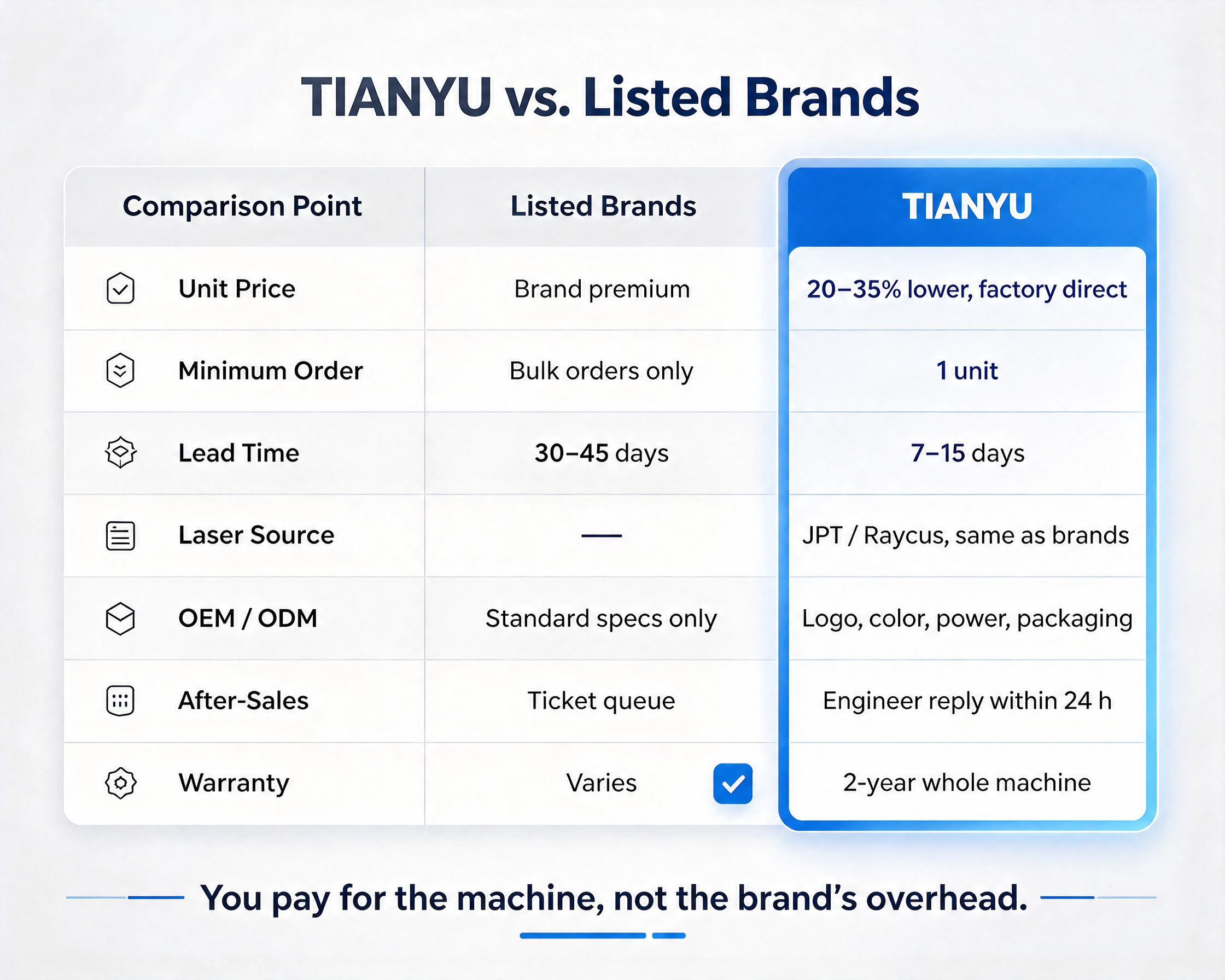
▴ Thin layers: laser wins on speed, waste and surface control. Thick layers: mechanical removal first, laser for the finish. Choosing the wrong sequence is where the money goes.
How to know before you spend
You do not need to buy a machine to find out which of the four cases you are in. You need three numbers and one photograph.
Send us: the material, the contaminant, its layer thickness, and the area to be cleaned. From those four data points we can tell you the honest removal rate — and, just as often, tell you that the job is a two-step process rather than a laser-only one. It costs you nothing, and it costs us a sale roughly one time in five. That is a trade we will take every time, because a machine that fails on your floor is worth less than no machine at all.
The bottom line
Four jobs the beam cannot do — and none of them is a defect.
Thick soft deposits (>1 mm grease, sludge, bitumen). Contamination soaked into pores. Coatings over about 1 mm. Transparent non-metals, where the beam passes straight through.
Everything thinner than about 300 µm on a metal substrate is where this machine earns its keep. Know which side of the line your part is on before you buy — not after.

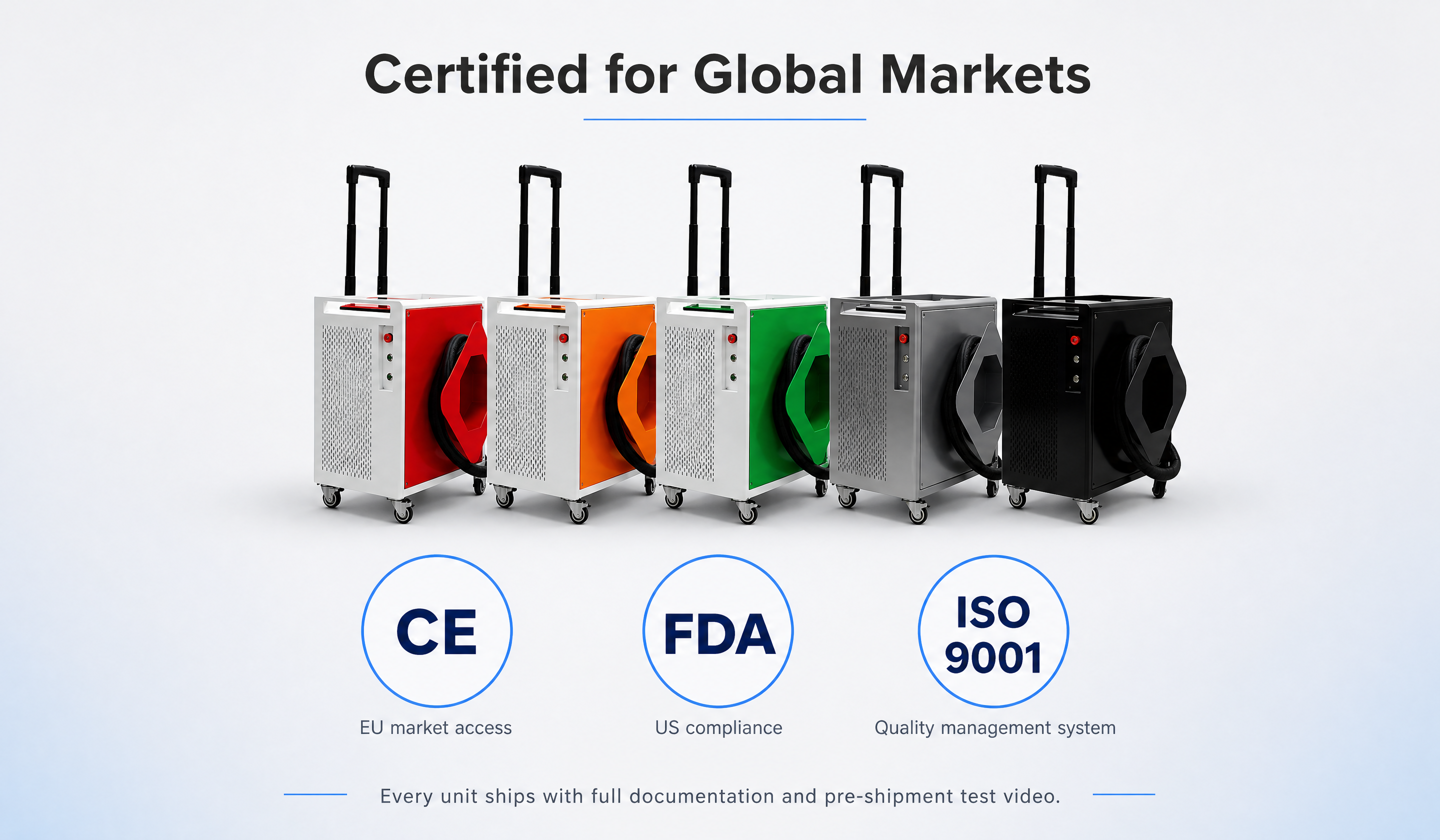
▴ TIANYU 500 W portable pulsed cleaner — 1064 nm, 1–200 ns adjustable pulse width, 10–80 mm adjustable scan width. CE certified, 100–6 000 W range available.
👉 Send us your part — we will tell you honestly if the laser can do it
Material + contaminant + layer thickness + area. We reply with the recommended power, scan width, estimated m²/h — or a straight “this is the wrong tool” — within 24 hours.
About Wuhan TIANYU Laser
Wuhan Maohe Tianyu Laser Equipment Co., Ltd. — 100 W to 6 000 W portable, benchtop and robotic laser cleaning & welding systems.
CE certified. Exporting to Europe, Southeast Asia and the Middle East.
OEM / ODM available for housing, power and scan width.
 ×
×

 EN
EN