
 EN
EN


The 500W Power Sweet Spot for Industrial Cleaning
A 500W pulsed fiber laser sits at the intersection of cleaning speed, surface safety, and operational cost. Below 200W, rust removal on 6 mm steel plate requires multiple passes, pushing cycle times above acceptable production thresholds. Above 1,000W, the risk of substrate thermal damage — warping, micro-cracking, surface annealing — increases sharply on thin or heat-sensitive components. The 500W power level delivers single-pass rust removal on most ferrous surfaces at 6 to 10 square meters per hour while maintaining substrate temperature below 80°C, well under the threshold that alters metallurgical properties. This power band is why a growing number of industrial facilities are adopting a laser welding machine and laser cleaning combination for an integrated production workflow — weld preparation, post-weld oxide removal, and surface finishing with one technology family.
Speed, Precision, and Substrate Safety at Mid-Range Power
Cleaning speed at 500W scales with beam diameter. A 150 mm scan at 4,000 to 6,000 Hz removes mill scale at 8 m²/h. Tighten to 50 mm and fluence triples, clearing heavy corrosion in one pass. The precision advantage is selectivity: the laser ablates the contaminant while the base metal reflects 1,064 nm with 85% to 95% efficiency. Handheld units weigh 10 to 15 kg, enabling weld-seam cleaning on assembled structures — a capability no blasting cabinet matches. A laser welding machine on the same production line benefits from surfaces prepared to this standard.
Real-World Case — An Automotive Parts Manufacturer Switches from Sandblasting
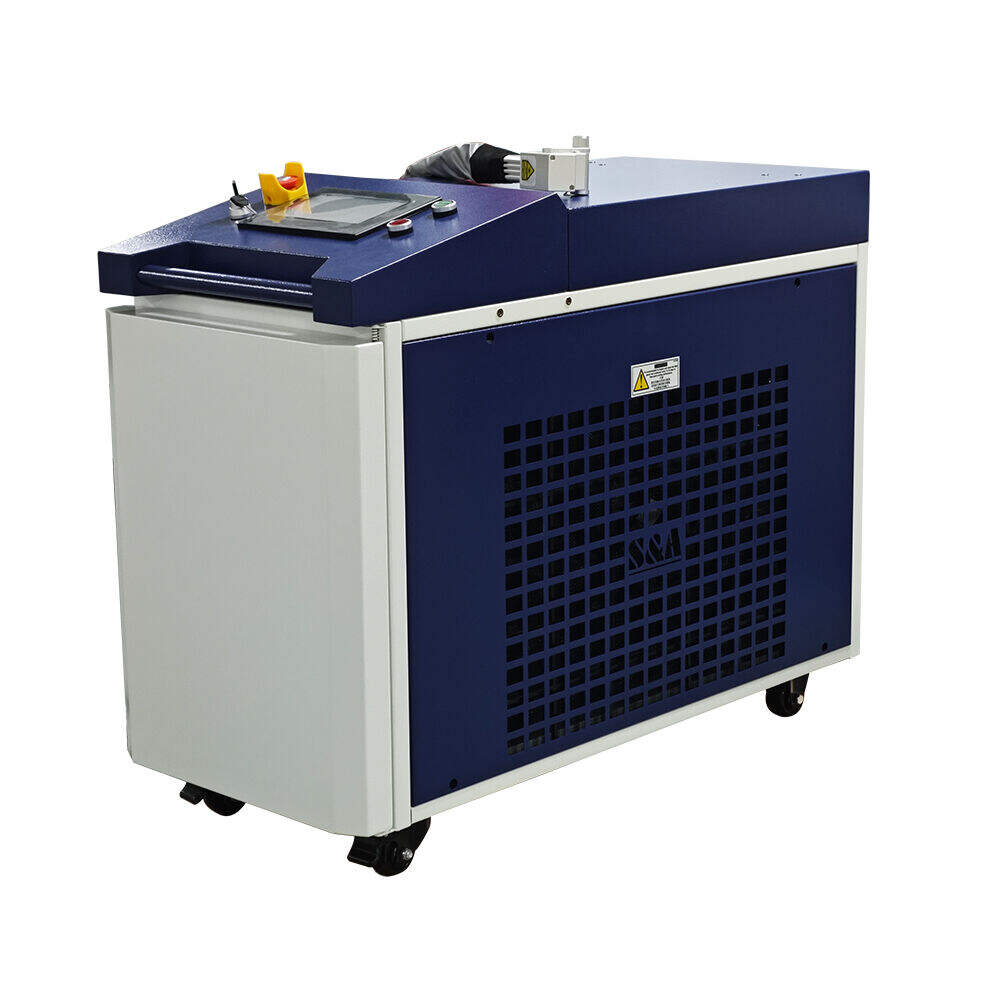
An automotive stamping plant in central Europe producing 80,000 brackets monthly was spending €14,000 per year on garnet media, hazardous waste disposal, and respiratory PPE for three operators. The plant integrated a 500W pulsed laser cleaning station from TYLASER (Wuhan Maohe Tianyu Laser Equipment), a manufacturer with 15 years of laser system experience and clients in over 140 countries. Cleaning time per bracket dropped from 90 seconds to 22 seconds. Media and waste costs went to zero. The station paid back in 14 months. The plant added a laser welding machine from TYLASER for bracket assembly, creating a single-technology process from surface prep to joining.
Operational Cost and Environmental Advantages
Consumable-Free Operation vs Media Blasting and Chemical Stripping
A 500W laser cleaning system consumes electricity and periodic lens replacement — approximately €0.60 per operating hour. Sandblasting at equivalent throughput consumes 25 to 40 kg of media per hour at €0.60 to €1.20 per kg, plus compressor energy, plus hazardous waste disposal. The laser generates no secondary waste. Ablated material converts to dust extracted by an integrated HEPA filtration system. No media to purchase, store, or dispose. A laser welding machine in the same shop benefits from the same consumable-free principle, reinforcing a unified laser-based production cell.
Applications Across Metals, Composites, and Delicate Surfaces
Rust Removal, Coating Stripping, Weld Preparation, and Mold Cleaning
A 500W laser cleaning system handles four applications. Rust removal on structural steel and cast iron — the laser ablates iron oxide without affecting the base metal. Coating stripping — epoxy, polyurethane, powder coat delaminate under thermal shock at the coating-substrate interface. Weld preparation — laser cleaning removes mill scale and oxidation from the weld zone, improving penetration consistency. A laser welding machine producing cleaner base metal achieves lower porosity. Mold cleaning — injection mold release agents and burned-on residues vaporize without the abrasion that degrades mold finish over hundreds of sandblasting cycles.
Selecting a 500W Laser Cleaning System for Production Environments
Beam Quality, Cooling, Safety Enclosure, and After-Sales Support
Not all 500W laser cleaners are equal. Beam quality — M² factor, where values below 1.5 indicate good single-mode fiber performance — determines focus tightness and energy distribution across the scan line. Cooling — air-cooled for handhelds, water-cooled for 24/7 stationary use — affects duty cycle. Safety — a Class 1 enclosure per IEC 60825-1 eliminates operator goggle requirements. After-sales — global service reach, remote diagnostics, and spare parts stocking prevent a single laser failure from stopping production. The same supplier quality applies when selecting a laser welding machine for the same facility — consistent support across the laser toolset reduces vendor management overhead. TYLASER serves over 140 countries with 24/7 response and 4-to-6-week delivery.
Frequently Asked Questions
What materials can a 500W laser cleaning machine process?
A 500W pulsed laser cleans ferrous metals, aluminum, copper, titanium, and composites. It removes rust, oxide layers, paint, epoxy coatings, oil, and mold release agents. Non-metallic substrates like stone and concrete can also be cleaned at reduced power. TYLASER provides material-specific parameter libraries.
Is laser cleaning safe for thin metal sheets?
Yes. A 500W laser with adjustable pulse duration and scanning speed limits substrate heating below 80°C, preventing warping on sheet metal as thin as 0.8 mm. A laser welding machine on the same line uses an entirely different parameter set optimized for joining rather than cleaning.
How does laser cleaning compare to sandblasting in cost?
Laser cleaning eliminates media purchase, compressor energy, and hazardous waste disposal — typically saving €10,000 to €20,000 annually over sandblasting at medium production volumes. Capital cost recovers in 12 to 18 months from consumable elimination.
Can a laser cleaning machine prepare surfaces for welding?
Yes. Laser cleaning removes mill scale, rust, and oils from the weld zone in a single pass, improving weld penetration and reducing porosity. A laser welding machine performs better on laser-cleaned surfaces than on mechanically cleaned ones.
What maintenance does a 500W laser cleaner require?
Protective lens cleaning or replacement every 200 to 500 operating hours, depending on fume density. Water-cooled systems require coolant changes every 6 to 12 months. TYLASER provides remote diagnostics and spare parts stocking.
Does laser cleaning work on painted surfaces?
Yes. The laser thermally shocks the paint-substrate interface, causing delamination without abrading the base metal. Multi-layer industrial coatings require 2 to 3 passes at 500W. Lead-based paint requires HEPA fume extraction verified to local environmental regulations.