
 EN
EN


How Collaborative Robot Laser Cleaning Combines Precision Optics with Automated Motion
Industrial surface cleaning has been a bottleneck for decades. Sandblasting fills the air with silica dust. Chemical stripping generates hazardous waste that requires licensed disposal. Manual grinding exposes workers to repetitive-strain injuries and inconsistent results across shifts. A laser cleaning machine attached to a collaborative robot — a six-axis articulated arm programmed to follow a part's exact contours — eliminates all three problems by directing pulsed laser energy at contaminants while the robot handles the motion, reach, and consistency that human operators cannot match across thousands of identical parts.
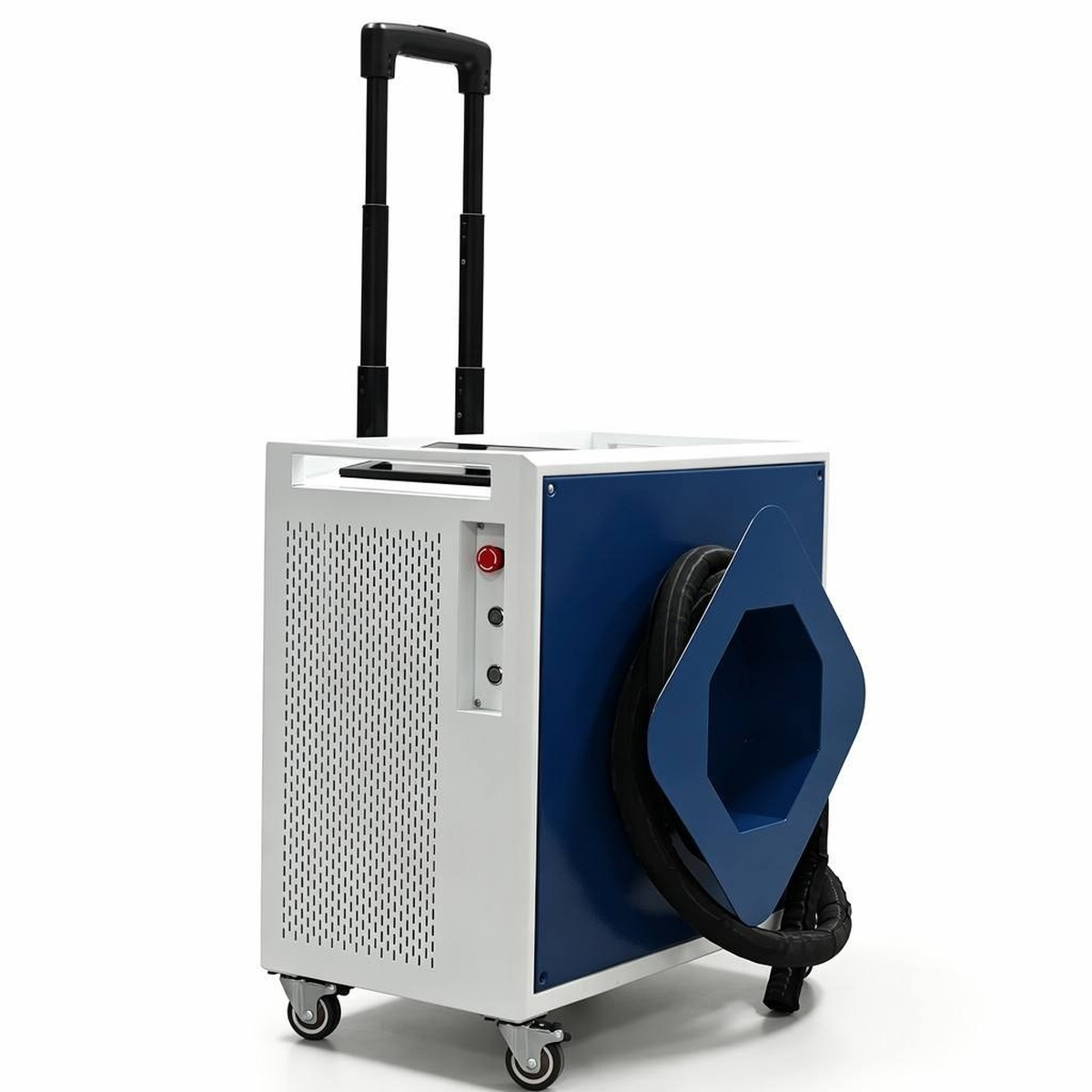
The technology behind collaborative robot laser cleaning starts with the laser source itself. A pulsed fiber laser generates high-energy light pulses measured in nanoseconds, each pulse delivering energy density above the contaminant's ablation threshold — typically 4.26 J/cm² for rust on carbon steel — but below the substrate's damage threshold. When the laser pulse strikes the contaminant layer, three physical processes occur simultaneously: photothermal vaporization (the contaminant absorbs laser energy and flash-evaporates), photomechanical shock (thermal expansion of the contaminant creates a pressure wave that fractures the bond to the substrate), and photo-acoustic lift-off (the shock wave propels vaporized particles away from the surface). The result is contaminant removal exceeding 95% without substrate damage, at cleaning rates of 15–35 square meters per hour on production-scale systems. Wuhan Maohe Tianyu Laser Equipment, operating from China's Optics Valley with 15 years of laser manufacturing experience and ISO/CE-certified production lines across 140+ export countries, produces pulsed laser cleaning machines compatible with collaborative robot integration — the laser cleaning machine becomes an end-effector on the robotic arm, with the robot controller coordinating cleaning-path motion and the laser controller managing pulse energy and frequency in real time.
Why Collaborative Robots Instead of Fixed Gantries
The Reach-and-Angle Problem
A fixed gantry laser cleaning machine cleaner directs the laser beam at a part positioned on a flat table — effective for flat plate stock, useless for curved ship hull sections, complex automotive stampings, or large-diameter pipe interiors. A collaborative robot's six-axis articulation positions the laser cleaning machine head at any angle relative to the part surface, maintaining the optimal focal distance and beam angle that laser cleaning requires. The robot's force-sensing joints also provide safety: if the arm contacts an unexpected obstacle, it stops within milliseconds — critical in mixed human-robot workspaces where sandblasting and chemical cleaning would require full isolation.
Real-World Application: An Automotive Stamping Line's Cleaning Automation
A Tier-1 automotive supplier producing 8,000 stamped body panels per day had been using manual solvent wiping to remove the mill scale and oxide layer from steel blanks before welding — a process that consumed 12 operator-hours per shift, created solvent-vapor exposure requiring respiratory PPE, and produced inconsistent surface cleanliness that caused weld-porosity defects in approximately 3% of assemblies.
The supplier integrated two Maohe Tianyu pulsed laser cleaning machines onto collaborative robot arms positioned on either side of the stamping press conveyor. The robots tracked each blank as it moved along the belt, the laser cleaning machine head sweeping the welding-edge zone in a programmed path that covered the 30 mm critical-weld margin. Cleaning time per blank dropped from 18 seconds (manual) to 6 seconds (robotic laser). The solvent inventory, PPE costs, and hazardous-waste disposal fees disappeared entirely — the laser cleaning machine produces only vaporized contaminant particles captured by a fume extraction unit. Weld-porosity defects dropped from 3% to 0.2%, saving approximately $140,000 annually in rework labor and scrapped assemblies.
Frequently Asked Questions
What laser power is needed for robotic laser cleaning?
Light-duty oxide removal on precision parts needs 50–100W. Rust and mill-scale removal on steel components needs 150–300W. Heavy paint stripping or thick corrosion removal requires 400W+. Maohe Tianyu's pulsed laser cleaning machines cover this power range with adjustable energy density for different contaminant-substrate combinations.
How fast can a collaborative robot laser cleaning machine clean?
Cleaning speed depends on laser power, contaminant type, and surface area. A 300W system cleaning light rust from flat steel achieves 25–35 m²/h. Heavy epoxy paint removal on complex-curvature surfaces drops to 8–12 m²/h. The robot's path speed is typically 50–200 mm/s depending on contaminant thickness.
Is robotic laser cleaning safe for operators?
Yes. Collaborative robots include force-limiting joints that stop on contact. The laser cleaning machine enclosure and fume extraction system capture vaporized particles. Operators need laser-safety eyewear rated for the specific wavelength (typically 1064 nm for fiber lasers) but do not need respiratory protection or hazmat suits. Maohe Tianyu's systems meet CE and REACH compliance standards.
Can a laser cleaning machine damage the substrate?
No — when correctly configured. The pulsed laser's energy density is set above the contaminant's ablation threshold but below the substrate damage threshold. Aluminum alloys require 60–80% of the fluence safe for carbon steel. Maohe Tianyu's technical team provides material-specific parameter guidance for each application.
What maintenance does a robotic laser cleaning system require?
Daily: clean the protective window on the laser head, check the fume extraction filter. Weekly: verify robot joint calibration, inspect fiber-optic cable for kinks. Monthly: clean chiller filters, check laser output power with a power meter. The fiber laser source has a rated life of 10,000 hours — approximately 5–7 years at 40 hours/week.
Can existing robots be retrofitted with a laser cleaning machine?
Yes — if the robot has sufficient payload capacity (the laser head typically weighs 2–5 kg plus the fiber-optic cable weight) and the controller supports auxiliary-device communication. Maohe Tianyu's laser cleaning machines communicate with robot controllers via standard I/O or industrial Ethernet protocols for coordinated path-and-pulse control.