
 EN
EN


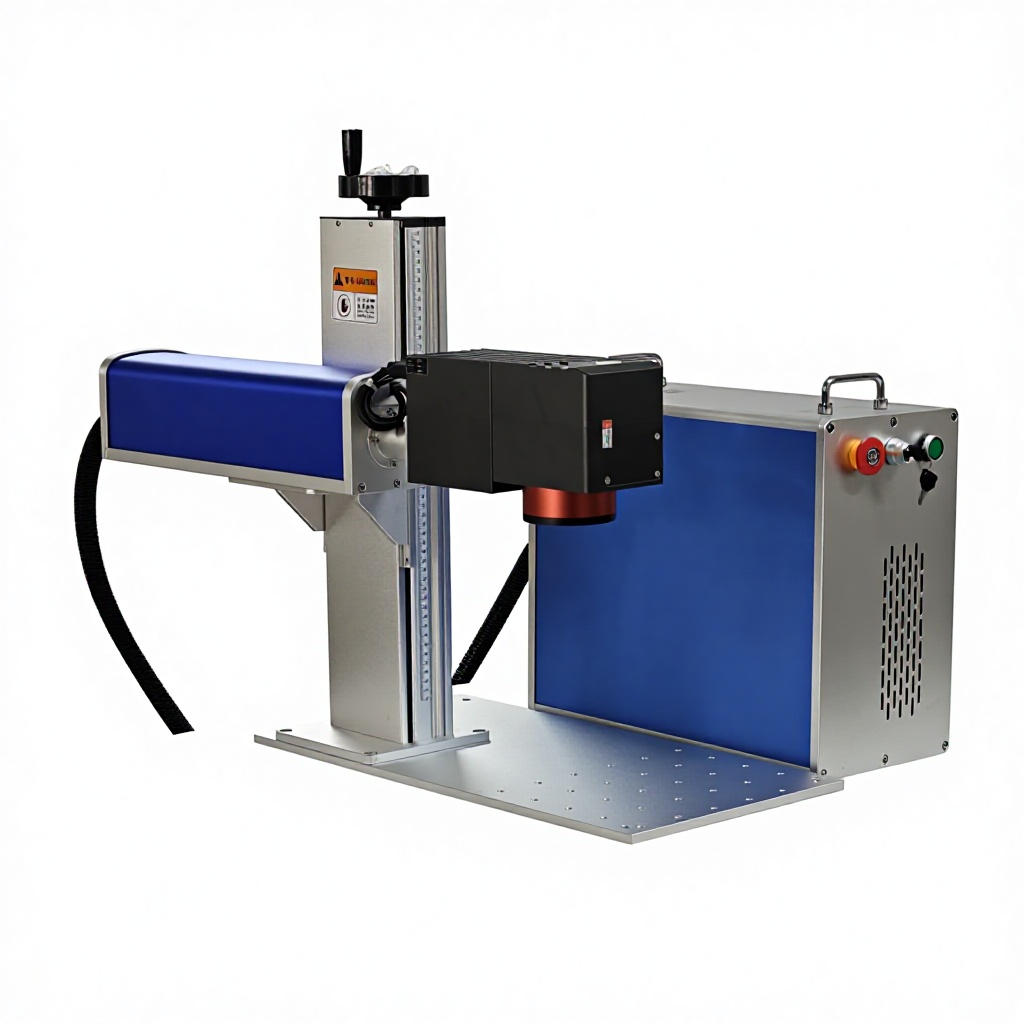
Fiber Laser Marking Machines: High-Speed Metal & Hard Material Marking
Operating in the near-infrared spectrum (1064 nm), fiber lasers deliver high photon absorption on conductive metallic surfaces. Approximately 70–85% of incident energy converts to localized heat, creating high-contrast, permanent annealing or etching marks.
Key Advantages
- Ultra-Long Lifespan: Fiber laser sources (such as Raycus, JPT, Max, or IPG) feature a service life of up to 100,000 hours with minimal maintenance.
- High Processing Speed: Galvo scanning systems achieve speeds up to 10,000 mm/s with ±0.01 mm repeatability.
- Zero Consumables: Purely electrical operation eliminating inks, ribbons, and solvents.
Common Applications
Automotive VIN plates, metal medical tools, hardware items, dark carbon-filled plastics, and industrial nameplates.
3. CO2 Laser Marking Machines: The Standard for Non-Metallic Substrates
CO2 gas lasers operate in the far-infrared band (10,600 nm). Because organic materials naturally absorb long-wavelength infrared light, CO2 markers instantly vaporize the surface layer of non-metals without requiring chemical additives or pre-treatments.
Key Advantages
- Superior Organic Material Absorption: Delivers clean, permanent contrast on wood, leather, paperboard, and glass.
- Flexible Format Options: Available in desktop enclosed cabinets, open-bed systems, and flying-marking configurations for continuous conveyor production lines.
Common Applications
Consumer product packaging, food packaging date codes, wine bottles, leather goods, and acrylic signage.
4. UV Laser Marking Machines: Damage-Free "Cold Marking" for Sensitive Substrates
Ultraviolet lasers utilize a short 355 nm wavelength with extremely high photon energy. Instead of burning or melting material, UV energy directly breaks chemical bonds at the molecular level—a process known as photochemical processing or "cold marking."
Key Advantages
- Zero Thermal Damage: Eliminates heat-affected zones (HAZ), preventing charring, surface melting, or structural degradation.
- Micro-Precision Resolution: Generates laser spot diameters down to 0.01 mm for microscopic 2D DataMatrix codes and ultra-thin line fonts.
Common Applications
Medical device UDI compliance marking, PCB chip marking, pharmaceutical blister packs, HDPE/polycarbonate packaging, and semiconductor manufacturing.
Real-World Case Study: One Contract Manufacturer, Three Laser Types
A contract manufacturer producing automotive components, medical device housings, and paperboard packaging initially deployed a single fiber laser marker across all three production lines:
- Metal Components: The fiber laser produced crisp, high-contrast serial numbers.
- Medical Polycarbonate Housings: The thermal heat from the fiber laser melted the plastic around the barcodes, causing 100% scan failures.
- Cardboard Packaging: The 1064 nm beam passed straight through without leaving a readable mark.
The Solution: The facility partnered with TY Laser engineers to deploy a multi-wavelength setup:
- Retained the Fiber Marker for metal components.
- Deployed a 355 nm UV Laser Marker for thermal-free medical plastic barcode printing.
- Integrated a CO2 Flying Laser Marker on the packaging line.
Result: 100% first-pass mark quality, zero material deformation rejects, and complete elimination of costly adhesive labels.
Industrial Customization & Factory-Direct OEM Solutions
Selecting the optimal laser marking machine requires evaluating line speed, material density, and automation integration.
At Wuhan Maohe Tianyu Laser Equipment (TY Laser), we offer tailored manufacturing solutions:
- Diverse Configurations: Handheld portable fiber markers (under 6 kg), compact desktop enclosures, and high-speed flying production line markers.
- Top-Tier Components: Equipped with industry-standard EZCAD control software and premium optical scanning galvos.
- Free Application Testing: Send us your material samples, and our application lab will provide free testing reports with recommended laser types, power levels, and parameter settings.
Ready to find the ideal laser marker for your production facility?
Contact TY Laser Application Engineers Today to request a free sample testing report, custom machine CAD designs, and factory-direct wholesale pricing.
Frequently Asked Questions (FAQ)
Can a fiber laser marking machine mark plastic?
Yes—but primarily dark-colored plastics containing carbon-black additives that absorb 1064 nm energy. Light-colored, transparent, or heat-sensitive plastics generally require a UV Laser or CO2 Laser to prevent burning or melting.
What is the typical service lifespan of an industrial laser source?
- Fiber Laser Sources: Rated up to 100,000 hours (~25 years under standard 40-hour workweeks).
- CO2 Laser Tubes: Typically 5,000 to 10,000 hours depending on tube type (glass vs. metal RF).
- UV Laser Diode Modules: Rated between 10,000 and 15,000 hours.
What software is used to control an industrial laser marking machine?
Most fiber, CO2, and UV markers operate on EZCAD software (JCZ platform). EZCAD supports vector graphics (AI, DXF, PLT), raster imagery (PNG, JPG), serial number auto-incrementation, dynamic QR codes, and automated production line triggers.
What maintenance and consumables do laser marking machines require?
Laser marking is a completely non-contact, consumable-free process. Unlike inkjet or pad printing, there are no inks, solvents, or printheads to replace. Periodic cleaning of the optical field lens is the primary routine maintenance required.
Table of Contents
- Fiber Laser Marking Machines: High-Speed Metal & Hard Material Marking
- 3. CO2 Laser Marking Machines: The Standard for Non-Metallic Substrates
- 4. UV Laser Marking Machines: Damage-Free "Cold Marking" for Sensitive Substrates
- Real-World Case Study: One Contract Manufacturer, Three Laser Types
- Industrial Customization & Factory-Direct OEM Solutions
- Frequently Asked Questions (FAQ)