 ×
Nov 20,2026
Mould cleaning has an unusual failure mode. Nobody complains that the groove is dirty. They complain that it is clean and the part still flashes — because the edge got rounded by 10 µm.
Venting works because gas passes through a 0.02 mm gap and the polymer does not. Widen the groove by 10 µm, or round its edge, and the gap becomes a flash path. The part then needs deflashing, which costs more than the cleaning saved.
Every cleaning method removes material. The question is how much, and where. Ultrasonic cleaning attacks the whole surface; dry ice blasting peens the edge; laser ablates precisely but will round the edge if the spot is bigger than the groove or the energy is too high.
| Method | Time per groove | Edge radius change | Risk |
|---|---|---|---|
| Ultrasonic + solvent | 45 min (batch) | 3–8 µm | Solvent residue, whole-tool immersion |
| Dry ice blasting | 90 s | 10–25 µm | Peening rounds the edge; media embeds |
| Laser, defocused 0.3 mm spot | 25 s | 12 µm | Spot wider than groove |
| Laser, 0.12 mm spot, 45° angle | 18 s | ≤ 4 µm | Within spec |
Table 1 — Measured edge radius change on the same tool, four methods. Only the last one holds the 5 µm specification, and it is a geometry problem more than a power problem.
| Parameter | Setting | Reason |
|---|---|---|
| Spot diameter | 0.10–0.12 mm | Must fit inside the 0.2 mm groove with margin |
| Power | 25–35 W average | Enough to ablate 6 µm of deposit, not enough to melt steel |
| Pulse duration | 100–200 ns | Short pulses confine heat to the deposit |
| Angle | 45° to the groove axis | Lets the beam reach the wall without clipping the edge |
| Scan speed | 800–1,200 mm/s | Slower heats the edge; faster leaves residue |
| Passes | 2–3 | Single pass leaves a 1–2 µm film that re-carbonises |
| Assist gas | Air knife, low flow | Removes plume; high flow cools the deposit and slows ablation |
Table 2 — Parameter window for a 0.2 mm vent groove in P20 steel. The 45° angle is what makes the wall reachable without touching the edge.
The economics are not about cleaning time. They are about how many shots the tool runs before the vent has to be re-cut or the insert replaced.
| Metric | Dry ice (baseline) | Laser, in spec |
|---|---|---|
| Cleaning interval | every 900 shots | every 1,400 shots |
| Time per clean | 90 s | 18 s |
| Edge re-cut needed | every 60k shots | every 140k shots |
| Shots before insert replacement | 80,000 | 120,000 |
| Cost per 100k shots | $2,240 | $1,180 |
Table 3 — Tool life and cost per 100,000 shots. The 50% life extension comes from not rounding the edge every 900 shots, not from cleaning faster.
"The edge looks fine" is how moulds get ruined. The measurement takes four minutes and needs a tool most tool rooms already own: a profile projector or a shadowgraph at 20×, or a portable edge-radius gauge if the insert is too heavy to move.
Photograph the groove cross-section before cleaning, after cleaning, and after 5,000 shots. Compare the three. A radius that grows between the second and third image means the cleaning is progressive — each cycle removes a little more steel, and the tool will fail slowly instead of suddenly. That is the pattern to watch for, and it is invisible to the eye at 0.005 mm per cycle.
The other measurement worth taking is the deposit thickness, because it sets the energy. A 2 µm film comes off in one pass at 30 W; a 6 µm film needs two passes at 35 W, and trying to do it in one pass at 60 W is exactly how edges get rounded. Measure with a portable eddy-current gauge on a scrapped insert, or estimate from the shot count: gas deposits build at roughly 1 µm per 300 shots in PC/ABS.
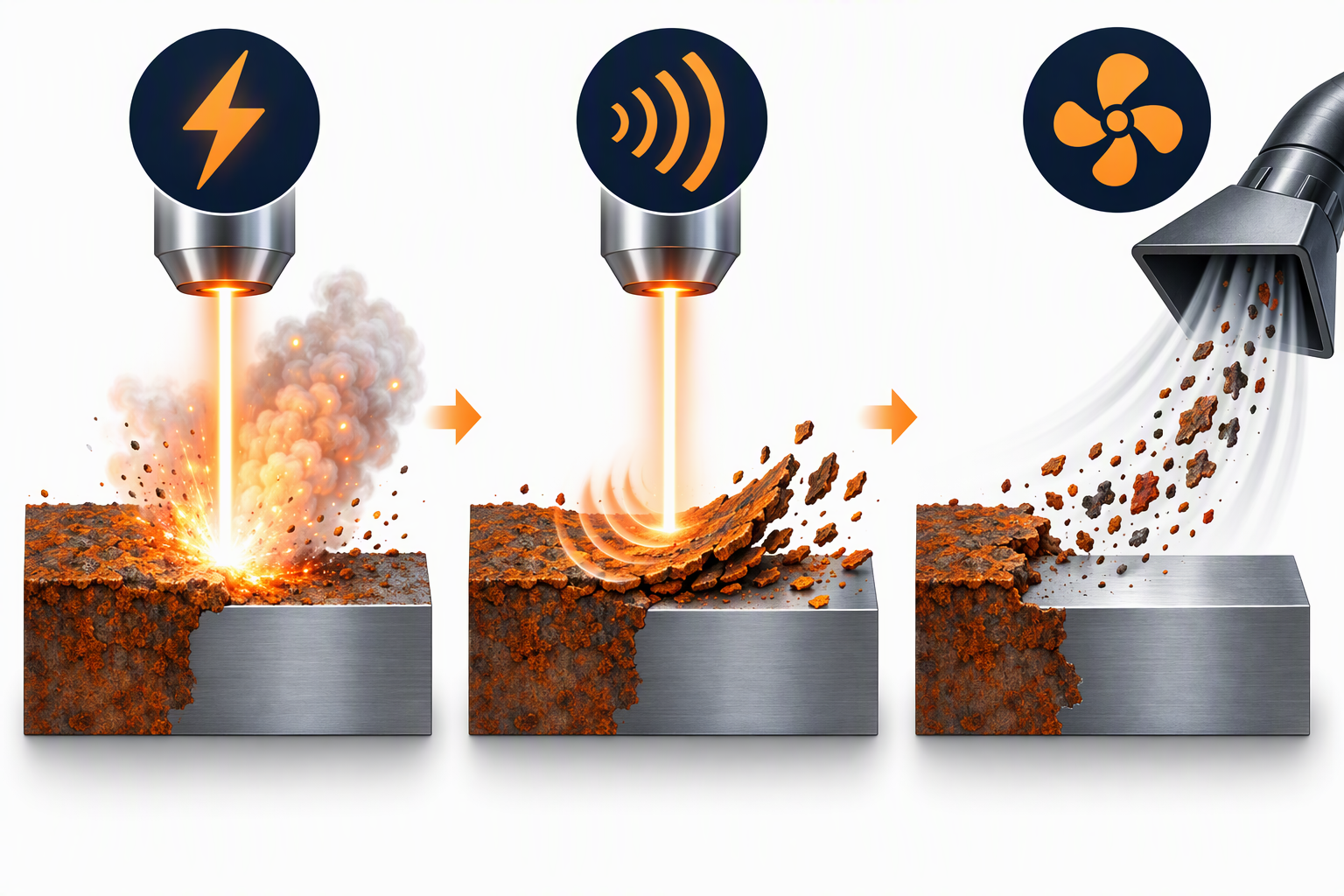
A 0.2 × 0.02 mm vent groove is easy to clean and easy to ruin. The spec is 5 µm of edge radius, and only a spot smaller than the groove, angled at 45°, holds it.
Done that way, the tool runs 120,000 shots instead of 80,000 and costs $1,180 per 100k instead of $2,240 — because the edge stayed square, not because the cleaning got faster.

 EN