 ×
×
Oct 14,2026
TIANYU Laser · 30-Day Laser Cleaning Series · No. 07 · 9 min read
#LaserCleaning#Specs#RustRemoval#EngineeringData#TIANYULaser
Laser cleaning is ablation, and ablation has a threshold. Below a certain energy density the surface simply heats and reflects; above it, material leaves. Depth does not scale with the number you bought — it scales with how far above threshold you push each pulse, and how many pulses you land on the same square millimetre. That gives one honest formula:
Read that again: three of the four variables are yours to set. Only the last one is decided by physics. So the question “how thick per pass?” can only be answered with a second question — “at which settings, on which material?”
| Dial | Unit | What it really controls | Typical 500 W range | Turn it up | Turn it down |
|---|---|---|---|---|---|
| 1. Power density (fluence) |
J/cm² | Energy landed per mm² of surface | 2–10 J/cm² | Deeper bite per pulse; risk of substrate heating | Safer on thin or heat-sensitive parts; slower |
| 2. Pulse width | ns | How fast the energy is dumped | 1–200 ns (typ. 60–120) |
Heat conducts into the part: thicker removal, larger HAZ | Cold ablation: precise, thin, minimal heat |
| 3. Scan speed & overlap |
mm/s & % | Effective pulses per mm of travel | 1 000–15 000 mm/s 30–90% |
Fewer pulses/mm → thinner per pass | More pulses/mm → thicker, slower, hotter |
That is the whole machine, in one table. Every “this laser is weak” complaint we hear traces back to one of these three being set for a different job than the one on the bench.
A 500 W head focused to a 0.4 mm spot and the same head at a 1.2 mm spot deliver the same total power and a 9× difference in fluence. That is why two buyers of the identical machine report wildly different removal rates: one is running a tight, hot spot and the other a wide, soft one.
Below the material's ablation threshold, extra passes just heat the part. Above it, depth climbs roughly linearly with fluence until plasma shielding starts eating the beam. For rust on steel, that sweet band sits around 4–8 J/cm². Go past 10 J/cm² and you are no longer cleaning faster — you are colouring the base metal.
Pulse width is the single most under-specified number on a quotation, and it changes the failure mode of the whole process. A 60–100 ns pulse dumps its energy faster than heat can diffuse into the metal, so the contaminant vaporises while the substrate stays cool — that is the mode that lets you clean a 0.8 mm sheet without warping it. Stretch the pulse to 180–200 ns and heat has time to conduct: you remove a thicker layer per pulse, but you also build a heat-affected zone and a visible tint.
Rule of thumb we give on the shop floor: thin part or heat-sensitive alloy → short pulse. Thick scale, no distortion risk → long pulse. Same machine, two completely different tools.
A 90% overlap means each millimetre of surface sees roughly ten pulses instead of one. That is why overlap is the cheapest way to buy depth — and the fastest way to overheat a part. On a 500 W head, dropping from 8 000 to 3 000 mm/s with the same overlap multiplies the pulses per mm by 2.7×, which is often the difference between “one pass and done” and “four passes and a warped panel.”
The practical ceiling: once the surface starts glowing bright orange, you have stopped removing and started heat-treating. Pull the speed back up.
Three dials are yours. The fourth is the material's, and it is the one that quietly decides whether a job is easy or impossible. At 1064 nm, absorption varies by more than 20× between common metals — and it is exactly this spread that makes laser cleaning work at all.
▴ Selective absorption at 1064 nm. Rust and paint absorb; clean metal reflects. This difference is what makes the process self-limiting — the beam stops doing damage the moment the contamination is gone.
| Material | Absorptivity @ 1064 nm | Cleaning behaviour | What you must adjust |
|---|---|---|---|
| Rust (Fe₂O₃ / Fe₃O₄) | 0.60–0.80 | Easy — high absorption, low threshold | Nothing; this is the design case |
| Paint & epoxy | 0.40–0.90 | Pigment-dependent: black & red easy, white/TiO₂ hard | More fluence or more overlap on light colours |
| Mild steel (clean) | 0.35–0.50 | Reflective — the beam self-stops at the base metal | Nothing; this is why it does not gouge |
| Stainless (polished) | 0.25–0.40 | Fine, but high fluence can deplete surface chrome | Cap fluence; short pulse |
| Aluminium | 0.05–0.15 | Very reflective; re-oxidises within minutes | Higher fluence, inert gas, clean-and-coat in one go |
| Copper / brass | 0.03–0.10 | Hardest common metal — it heats before it cleans | Short pulse, high peak power, patience |
The mild-steel row is the one to remember. Because clean steel reflects far more of the beam than rust does, the process is self-limiting: the moment the last micron of oxide is gone, absorption collapses and the beam stops removing material. That is the physical reason a laser cleaner can strip rust to bright metal without grinding into the part — and it is not a software feature.
A rate without its settings is marketing. Here is the same 500 W pulsed head, 1064 nm, on five common jobs — settings included, so you can reproduce or argue with them.
| Job | Layer | Fluence | Pulse width | Scan speed | Overlap | Depth / pass | Passes to finish |
|---|---|---|---|---|---|---|---|
| Light surface rust | 10–40 µm | 6 J/cm² | 100 ns | 8 000 mm/s | 60% | 20–40 µm (full layer) |
1 |
| Mill scale / black oxide | 20–60 µm | 8 J/cm² | 120 ns | 5 000 mm/s | 75% | 25–50 µm | 1 |
| Single-coat paint | 30–80 µm | 5 J/cm² | 80 ns | 6 000 mm/s | 70% | 30–60 µm | 1 |
| Heavy flaking rust | 0.2–0.5 mm | 9 J/cm² | 150 ns | 3 000 mm/s | 80% | 0.08–0.15 mm | 2–4 |
| Epoxy / multi-coat | 100–300 µm | 10 J/cm² | 200 ns | 1 500 mm/s | 85% | 0.05–0.10 mm | 3–5 |
Read the last column and the pattern is obvious: the beam wins whenever one pass can finish the job, and it loses whenever the layer forces you into three or more passes. That is the practical definition of “too thick” — not a millimetre figure, but the point where the pass count climbs.
You do not need our settings — you need the order to set them in. Get this sequence wrong and you will spend an afternoon chasing your own tail:
Step 1 — Set the pulse width first, from the part, not the dirt. Thin sheet, precision part or heat-sensitive alloy: 60–100 ns. Thick, rigid, distortion-tolerant steel: 150–200 ns. This dial protects the workpiece, so it goes first.
Step 2 — Raise fluence until the layer gives up, starting at 4 J/cm² and stepping up. Stop the moment the surface cleans in one pass. Going higher does not clean faster; it starts tinting the base metal.
Step 3 — Set scan speed and overlap last, to convert your chosen fluence into a work rate. Fast and light for large flat panels; slow and tight for localised scale. Then leave it alone.
Two minutes of this beats an hour of guessing, and it is exactly the order the settings in the table above were found in.
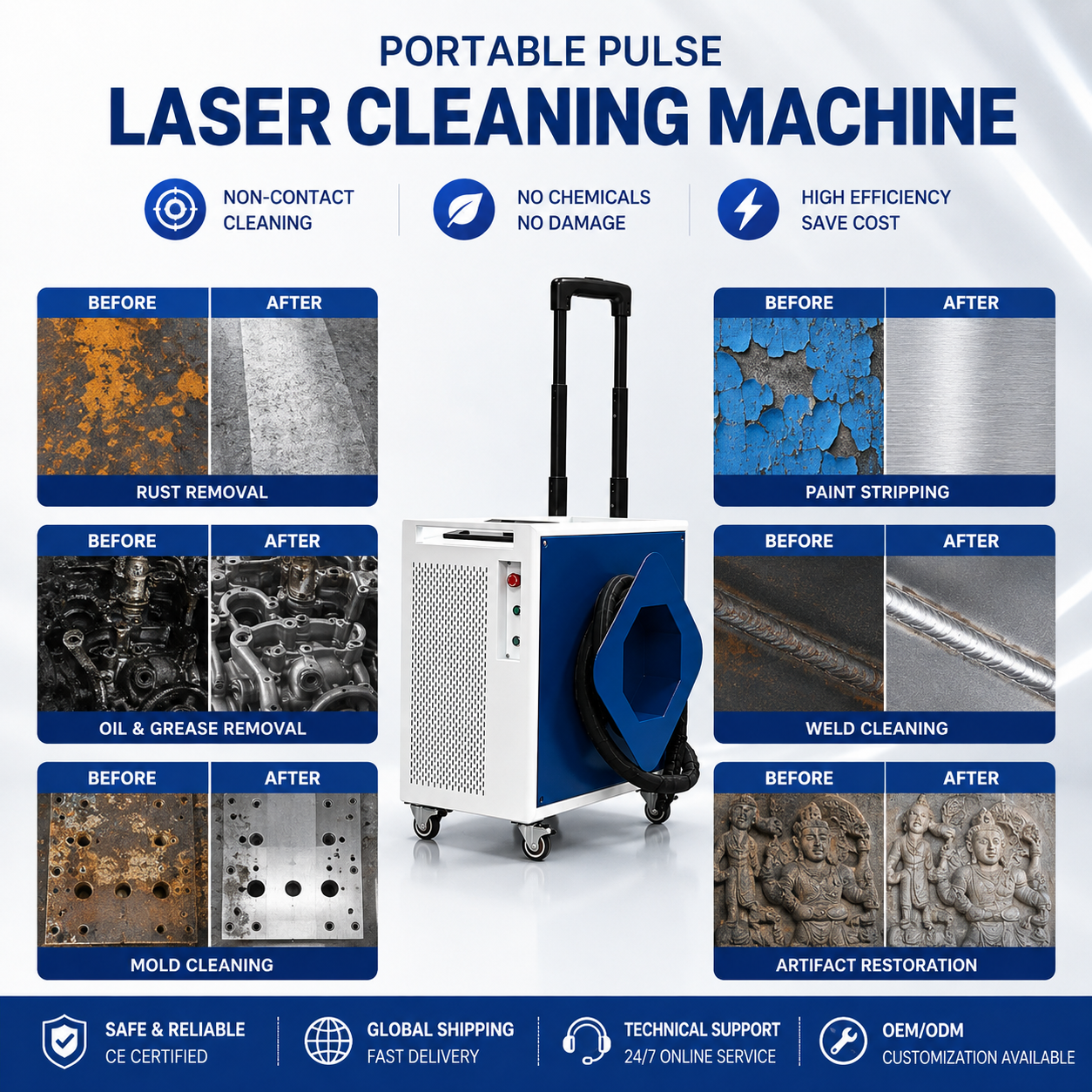
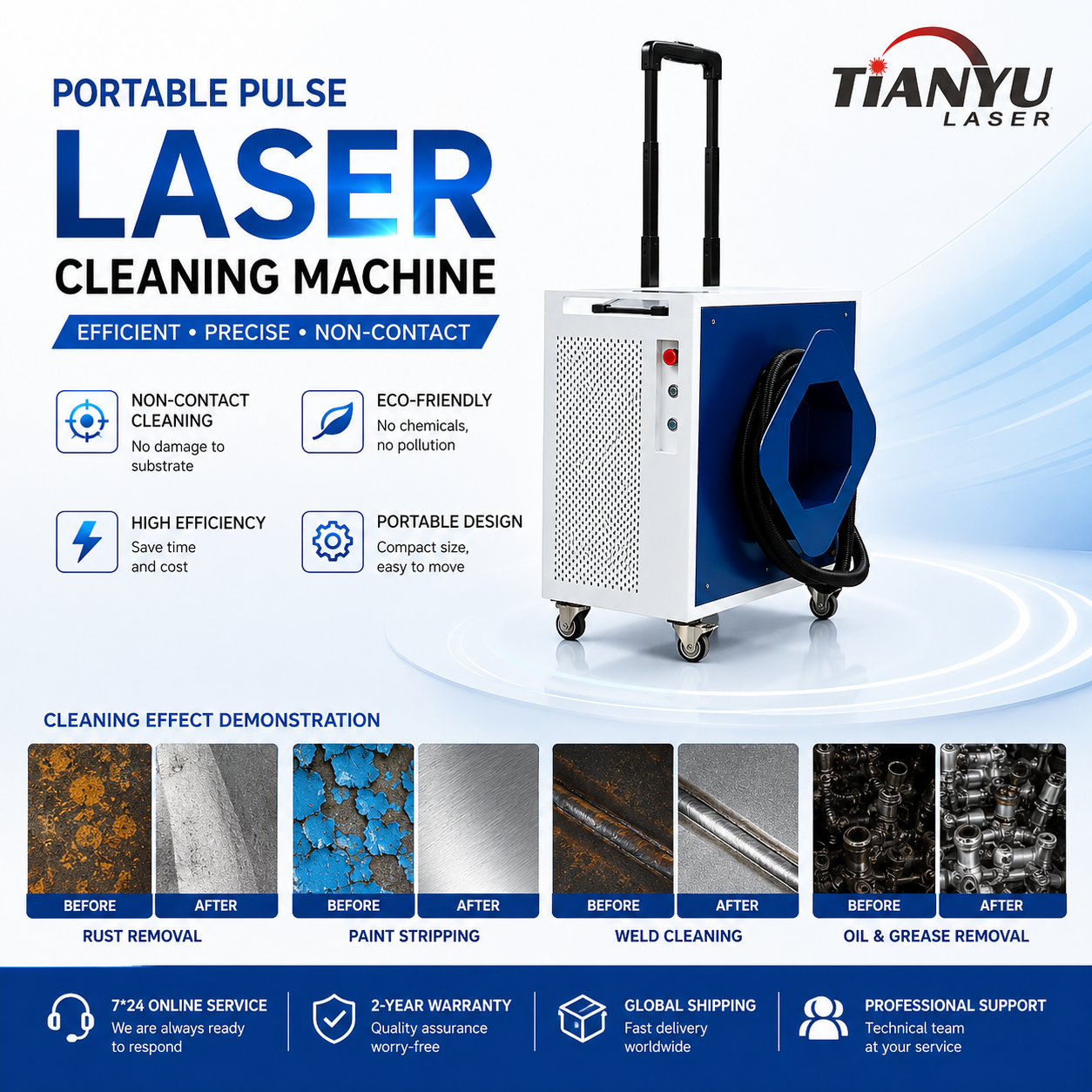
▴ TIANYU 500 W portable pulsed cleaner — 1064 nm, 1–200 ns adjustable pulse width, 10–80 mm adjustable scan width. CE certified, 100–6 000 W range available.
👉 Send us your part — we will send back the exact 3 settings
Material + contaminant + layer thickness + part geometry. We reply with the recommended power, pulse width, scan speed and overlap, plus the expected m²/h and per-pass depth — within 24 hours.
About Wuhan TIANYU Laser
Wuhan Maohe Tianyu Laser Equipment Co., Ltd. — 100 W to 6 000 W portable, benchtop and robotic laser cleaning & welding systems.
CE certified. Exporting to Europe, Southeast Asia and the Middle East.
OEM / ODM available for housing, power and scan width.
Part 07 of the "30 Laser Cleaning Questions" series.
Next → "Will Rust Come Back Right After Cleaning? What Decides How Long It Lasts"
Follow us — one practical insight every day.

 EN
EN