
 EN
EN



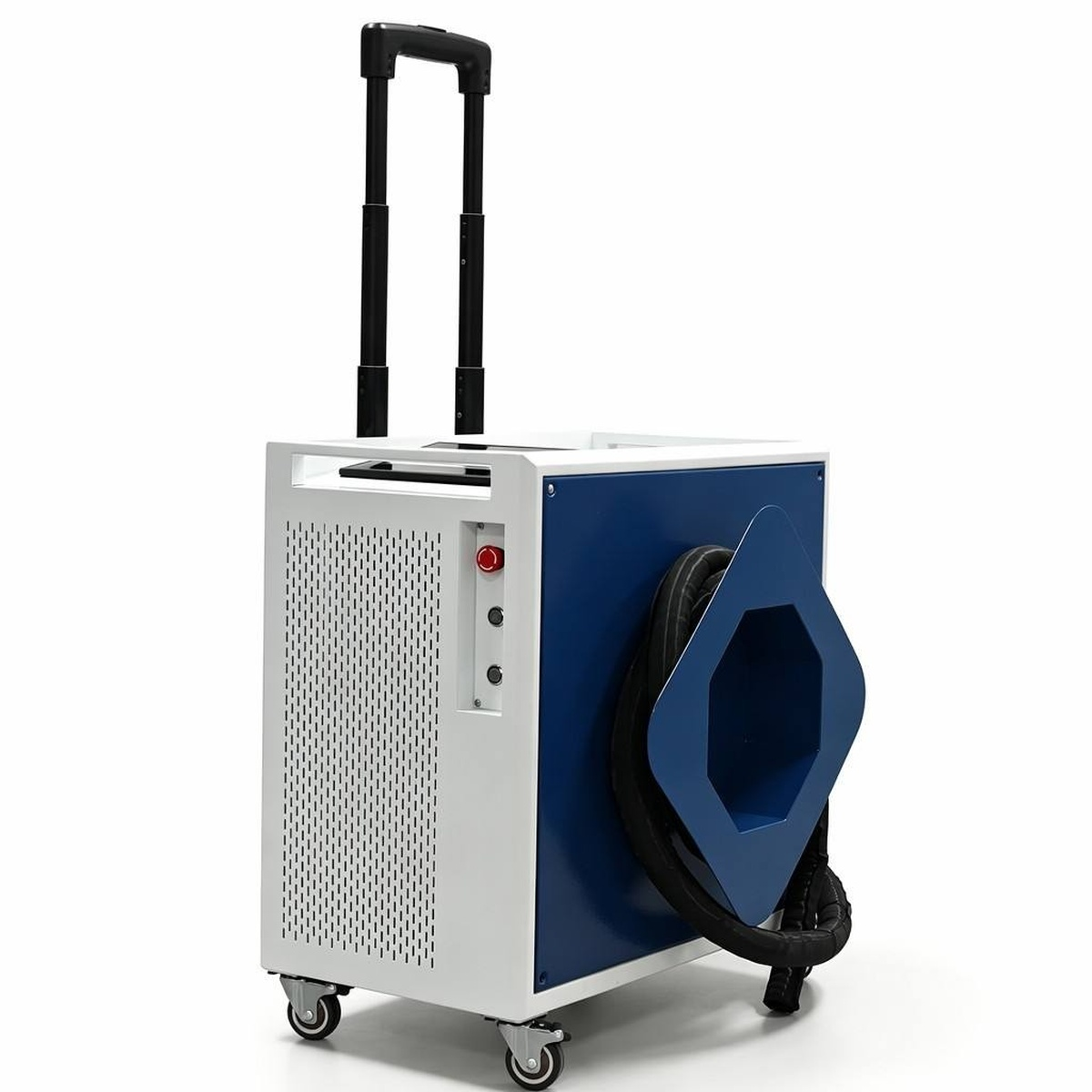
How Power Output Affects Cleaning Efficiency and Material Removal
Wattage as ablation energy: translating 1000W, 1500W, and 2000W into removal rate and pass-count reduction
Power directly governs the ablation energy a laser cleaning machine delivers to the surface. As wattage increases, energy per unit time rises—accelerating evaporative removal of contaminants and reducing required passes. Benchmarks on standardized rusted steel illustrate this progression: a 1000W system achieves ~35 cm²/s, a 1500W unit reaches ~58 cm²/s, and a 2000W configuration delivers ~82 cm²/s (Industrial Laser Cleaning Applications Report 2023). This near-linear scaling means a 2000W machine can perform in one pass what a 1000W system requires three passes to complete—slashing process time significantly. For example, removing 50 µm of mill scale from carbon steel typically demands two passes at 1500W but only one at 2000W, while a 1000W source may require three or more. Higher energy density also supports faster scanning speeds, further boosting throughput. However, optimal pass-count reduction depends critically on contaminant type, thickness, and substrate thermal properties—not just wattage. Operators must balance speed gains against excessive heat input, which risks warping delicate materials.
CW vs. pulsed operation: why identical wattage doesn’t guarantee equivalent performance in real-world laser cleaning machine applications
Equal wattage ratings do not guarantee identical cleaning outcomes because the temporal delivery of energy—continuous wave (CW) versus pulsed—fundamentally alters laser–material interaction. A 1500W pulsed laser concentrates energy into short, high-peak-power bursts, enabling precise ablation of thin coatings or light rust with minimal heat diffusion into the substrate. In contrast, a 1500W CW laser emits a constant beam, excelling at high-speed bulk removal of thick paint or heavy corrosion—but introducing a larger heat-affected zone. This distinction is critical for thermally sensitive components: a pulsed 1500W system can safely clean aerospace-grade alloys without discoloration or distortion, whereas a CW 1500W unit may compromise surface integrity. Real-world evidence shows that, for precision restoration tasks, a 1500W pulsed laser often outperforms a 2000W CW system—underscoring that mode selection is as consequential as power rating.
Application Matching: Which Laser Cleaning Machine Power Tier Fits Your Use Case?
Selecting the correct power tier for a laser cleaning machine is a critical decision that directly impacts process efficiency, substrate integrity, and operational cost. The three core power levels—1000W, 1500W, and 2000W—each serve distinct industrial niches. Application matching is not about choosing the highest available wattage, but about aligning the system’s ablation energy with the specific contaminant profile and the thermal sensitivity of the base material. A mismatch can lead to either insufficient cleaning or costly thermal deformation.
1000W laser cleaning machine: precision cleaning for thin coatings, light rust, and heat-sensitive substrates
A 1000W laser cleaning machine represents the entry point for high-precision industrial applications where substrate integrity is non-negotiable. It is the preferred tool for removing light flash rust from tooling, stripping thin oxide layers from aluminum heat sinks, or preparing heat-sensitive alloys for welding. Its energy density is finely controlled to ablate only the contaminant layer—without inducing a measurable heat-affected zone (HAZ) in the parent material. In electronics manufacturing or classic car restoration, for instance, it safely removes conformal coatings or aged lacquer from panels where higher-power systems would risk warping. This tier prioritizes single-pass precision over raw speed, making it ideal for high-value, detail-oriented work.
1500W laser cleaning machine: optimal balance for mid-volume industrial cleaning (e.g., welded steel, painted surfaces)
The 1500W laser cleaning machine hits a strategic sweet spot for general manufacturing and maintenance operations—delivering an optimal balance between cleaning speed and operational safety. It serves as the workhorse for mid-volume tasks such as pre-weld treatment of structural steel, removal of robust epoxy paints from machine beds, and comprehensive mold cleaning in tire production. At this power level, technicians can clear a 50 µm layer of paint at up to 3.8 m²/h—a throughput that keeps pace with fabrication line demands while avoiding the thermal risks associated with higher power. Its versatility enables seamless transitions between robotic weld-cleaning cells and handheld paint-stripping applications—making it the strongest ROI choice for job shops requiring a single, adaptable platform.
2000W laser cleaning machine: high-throughput removal of heavy oxides, thick paint, and corrosion on large structural components
When contaminants measure in millimeters—not microns—a 2000W laser cleaning machine is the only effective solution. Engineered for aggressive, high-throughput removal on large structural components, it excels at stripping multi-layer anti-corrosion coatings from ship hulls, removing heavy mill scale from I-beams, or decontaminating concrete floors. Its photon density enables an ablation rate approximately 2.3× faster than a 1000W unit on comparable rust profiles—reaching over 80 cm²/s of heavily corroded steel. The primary advantage is logistical: completing a 50-square-meter hull section in a single shift versus a multi-day abrasive blasting operation. This tier is not designed for precision—it is purpose-built for heavy industry where eliminating media consumption, reducing labor hours, and minimizing pass counts are top priorities.
Performance Benchmarks: Speed, Coverage, and Consistency Across Power Levels
Measured throughput comparison: 35 cm²/s (1000W), 58 cm²/s (1500W), and 82 cm²/s (2000W) on standardized rusted steel
Throughput is the most direct indicator of productivity when evaluating a laser cleaning machine. On standardized rusted steel, measured ablation rates are 35 cm²/s (1000W), 58 cm²/s (1500W), and 82 cm²/s (2000W)—a progression reflecting both increased fluence and improved beam utilization. The 65% gain from 1000W to 1500W meaningfully reduces pass counts on mid-thickness coatings; the jump to 2000W delivers nearly 2.3× the baseline speed. Crucially, real-world consistency depends on uniform power distribution across the scan width. Field data from industrial trials show that 1500W and 2000W systems maintain ±5% ablation uniformity over a 50 mm line—enabling full-width, non-overlapping passes. Some 1000W systems exhibit edge drop-off, requiring slower scanning or overlap to ensure complete coverage—eroding their nominal throughput advantage. Thus, while the 35/58/82 cm²/s figures provide a reliable benchmark, actual cycle time hinges on optical and motion-control fidelity.
Operational Trade-offs: Thermal Risk, Accuracy, and Total Cost of Ownership
Subsurface heating and material integrity: 40% higher thermal load with 2000W vs. 1000W on copper and aluminum alloys
Higher wattage directly increases subsurface thermal load—and therefore the risk of damage to sensitive substrates. Independent testing on copper and aluminum alloys reveals a 40% greater thermal load using a 2000W source compared to a 1000W unit. This intense localized heating can exceed melting thresholds, induce microstructural changes, or create unwanted HAZ—compromising fatigue life, dimensional stability, and corrosion resistance. In contrast, the lower energy density of a 1000W system allows heat to dissipate efficiently, preserving the metallurgical integrity of thin-walled or high-value components. The trade-off is unambiguous: 2000W delivers unmatched throughput, but 1000W provides irreplaceable thermal control where part integrity is paramount.
Energy consumption, cooling demands, and maintenance frequency by laser cleaning machine power rating
Total cost of ownership (TCO) for a laser cleaning machine extends far beyond its purchase price. A 2000W system consumes significantly more electrical power per operating hour than a 1000W unit—driving up utility costs and demanding a more robust, energy-intensive chiller to stabilize laser diode temperatures. Thermal stress on optics and pump diodes also increases, shortening service intervals. The table below summarizes comparative operational demands:
| Power Tier | Relative Energy Consumption | Cooling System Complexity | Typical Maintenance Window |
|---|---|---|---|
| 1000W | Low | Basic air or compact water chiller | Annual |
| 1500W | Moderate | Mid-range industrial water chiller | Bi-annual |
| 2000W | High | High-capacity, high-flow water chiller | Quarterly |
Facility managers must weigh the throughput advantages of a 2000W system against the lower utility bills, reduced infrastructure requirements, and longer service cycles of lower-tier models—especially in environments where peak cleaning demand does not justify continuous high-power operation.
FAQ Section
What factors influence the cleaning efficiency of a laser cleaning machine?
Cleaning efficiency is influenced by power output (wattage), contaminant type and thickness, substrate thermal sensitivity, beam mode (CW vs. pulsed), and the scanning speed of the machine.
How does wattage affect throughput in laser cleaning machines?
Higher wattage translates to greater energy density, leading to faster ablation rates and reduced pass counts. For example, 2000W machines can achieve up to 82 cm²/s compared to 35 cm²/s for 1000W systems.
What is the difference between CW and pulsed operation?
CW (continuous wave) lasers provide a steady energy output, ideal for bulk removal, while pulsed lasers deliver short bursts of high-peak energy, enabling precise ablation with minimal heat diffusion.
Which power tier should I choose for thermally sensitive substrates?
A 1000W system is best for thermally sensitive substrates, as it provides controlled energy density that minimizes heat-affected zones and prevents material deformation.
What are the operational costs associated with higher-power laser cleaning machines?
Higher-power machines, such as 2000W models, involve higher energy consumption, more complex cooling systems, and shorter maintenance intervals compared to lower-power units.
Table of Contents
- How Power Output Affects Cleaning Efficiency and Material Removal
-
Application Matching: Which Laser Cleaning Machine Power Tier Fits Your Use Case?
- 1000W laser cleaning machine: precision cleaning for thin coatings, light rust, and heat-sensitive substrates
- 1500W laser cleaning machine: optimal balance for mid-volume industrial cleaning (e.g., welded steel, painted surfaces)
- 2000W laser cleaning machine: high-throughput removal of heavy oxides, thick paint, and corrosion on large structural components
- Performance Benchmarks: Speed, Coverage, and Consistency Across Power Levels
- Operational Trade-offs: Thermal Risk, Accuracy, and Total Cost of Ownership
-
FAQ Section
- What factors influence the cleaning efficiency of a laser cleaning machine?
- How does wattage affect throughput in laser cleaning machines?
- What is the difference between CW and pulsed operation?
- Which power tier should I choose for thermally sensitive substrates?
- What are the operational costs associated with higher-power laser cleaning machines?