
 EN



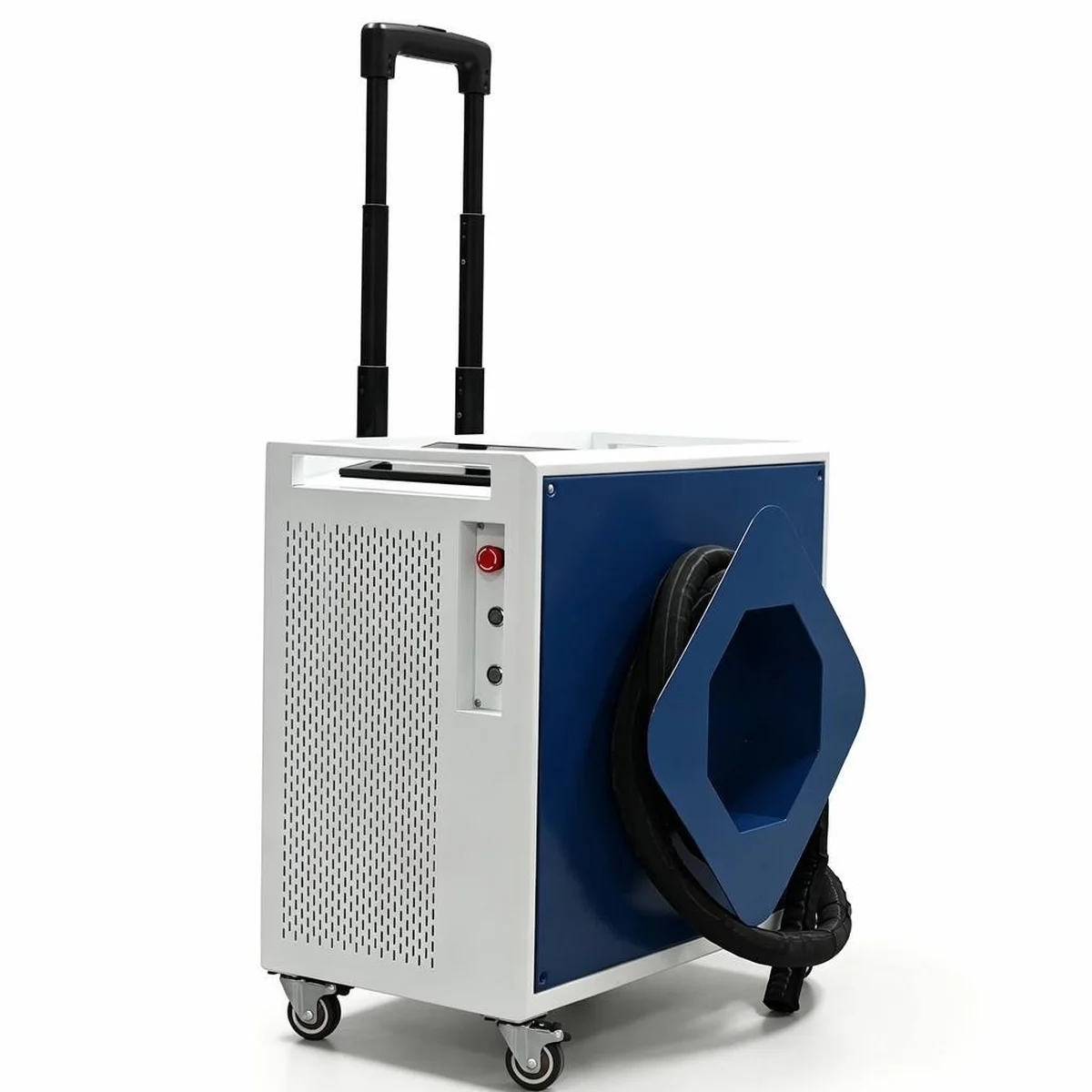
Lessons From the Field
A maintenance crew at a regional rail yard faced a familiar problem: thousands of steel brackets coated in layered rust and flaking paint, all needing clean metal before a fresh protective coat. The team had two weeks and no permission to shut the active line for long. A handheld laser cleaning machine proved the practical answer because it moved to the work instead of the work moving to a fixed cabinet.
A Rail-Yard Repaint Prep Story
Technicians advanced along the brackets with the portable unit, lifting rust without grit, chemicals, or water. Unlike a sandblaster, the handheld laser cleaning machine produced no secondary waste stream that required containment and disposal. The crew finished the section ahead of schedule, and the new coating bonded without the bubbling that old chemical residues had caused in previous years.
A second scenario involved a heritage bridge restoration where substrate thickness mattered. Here the handheld laser cleaning machine allowed controlled removal of a corrosion crust while preserving the original steel beneath. The project lead noted that pulse parameters could be tuned on site, something larger fixed systems could not offer on a moving job with awkward access and tight deadlines.
These field cases share a clear pattern. The handheld laser cleaning machine earns its place when access is awkward, batches are small, or the workpiece cannot move to a stationary enclosure. The trade-off is operator attention: someone holds the gun, so technique and training decide the outcome as much as the hardware does. Before trusting a handheld laser cleaning machine on a production line, weigh those human factors alongside the spec sheet.
The Risks Operators Should Weigh
Beam safety sits at the top of any honest assessment, and the quiet substrate risk follows close behind. Both are manageable with discipline, yet both are easy to underestimate when a demo runs smoothly on a clean sample rather than a real, irregular part under shift pressure.
Eye and Skin Exposure
A handheld laser cleaning machine emits a concentrated beam that can injure eyes and skin in a fraction of a second. Reflections from shiny metal travel farther than most expect, and the person holding the tool is closest to that hazard. Proper enclosures, interlocks, and certified eyewear are not optional extras but baseline conditions for lawful use under IEC 60825-1 and EN 60825.
Operators new to a handheld laser cleaning machine often underestimate setup discipline. A missed interlock, a scratched lens, or a blocked extractor turns a safe process into a hazardous one within a single shift. The advantage of portability collapses if the site lacks the enclosures and procedures that a fixed cabin provides by default, so the cell matters more than the gun.
Substrate and Coating Damage
Too much pulse energy on thin sheet or on a delicate coating burns the base material instead of the contaminant. A handheld laser cleaning machine gives the operator direct control, which means a tired or rushed hand can over-treat a surface. Heat buildup on heat-sensitive parts also warps geometry that cannot be restored once lost, a cost no schedule recovers.
There is also the question of fumes. Ablated paint, rust, and coatings release particulate and occasionally hazardous vapors. A handheld laser cleaning machine should run with extraction rated for the specific contaminant, or the operator breathes the very layer being removed. This risk is rarely the first mentioned in a sales conversation, yet it shapes daily practice more than the brochure suggests.
How the Handheld Laser Cleaning Machine Works
The core principle is selective ablation, and the safety frame around it is built from named international standards. Understanding both explains why the same tool can be a careful restorer in one hand and a hazard in another, depending entirely on the parameters and the enclosure chosen for the job.
Pulse Energy Meets the Ablation Threshold
A pulsed beam delivers energy faster than the contaminant can dissipate it, so the rust or paint heats, vaporizes, or sheds while the underlying metal stays cool. A handheld laser cleaning machine reaches what engineers call the ablation threshold: enough power to strip the top layer, not enough to mark the substrate underneath. Pulse width and frequency decide the result.
Short pulses spare heat-affected zones; higher repetition clears area faster but demands cooling discipline. Global safety rules frame this work through IEC 60825-1 and EN 60825 for laser product safety, ISO 11553 for machinery, and EN 12100 for risk assessment. The EU Machinery Directive 2006/42/EC and CE marking sit behind compliant equipment sold into Europe. Wuhan Maohe Tianyu Laser Equipment Co., Ltd. builds to these references for export markets.
A handheld laser cleaning machine also depends on beam delivery. A clean focus lens and stable fiber path keep the spot where it belongs. When the optics drift, the same pulse that should lift rust can instead scorch the part. This is why the engineering and the daily habits of the operator are two halves of one safe process rather than separate concerns that can be ignored after purchase.
Choosing the right handheld laser cleaning machine starts with the contaminant profile, not the catalogue headline. Light surface oxide and heavy mill scale respond to different pulse recipes, and the gap between them explains most field disappointments. A source factory that documents these settings gives the operator a head start that generic resellers rarely match when the part finally reaches the floor.
Selection, Inspection, Use, and Maintenance
Inspection
A daily check takes minutes and prevents most failures. Verify lens clarity, confirm interlocks trip, test the extraction flow, and scan the cable for kinks. A handheld laser cleaning machine that passes these checks each shift is far less likely to surprise the operator mid-job. Log the checks so patterns of wear become visible before they cause downtime on a critical contract with a fixed delivery date.
Frequently Asked Questions
Is a handheld laser cleaning machine safe for indoor workshops?
Answer: Indoor use is possible only with fixed enclosures, certified laser eyewear, and rated fume extraction. The beam and its reflections remain hazardous, so a handheld laser cleaning machine must run inside a controlled cell or behind barriers that meet IEC 60825-1 and EN 12100. Without those controls, the portability advantage creates unacceptable exposure risk for anyone nearby in the same room during operation.
What contaminants can a handheld laser cleaning machine remove?
Answer: Rust, mill scale, paint, oil, and many oxide layers come off cleanly when the pulse recipe matches the coating. A handheld laser cleaning machine struggles with contaminants that sit below the ablation threshold of the base metal or with deep pitting that needs mechanical repair. Test coupons on the actual part confirm the result before a full production run begins on client work.
How does a handheld laser cleaning machine compare with sandblasting?
Answer: Sandblasting generates abrasive waste and containment cost, while a handheld laser cleaning machine leaves no secondary stream and needs no grit supply. The laser is slower on thick crusts but far cleaner in confined spaces. A handheld laser cleaning machine also preserves substrate thickness, which sandblasting gradually erodes across repeated maintenance cycles on the same component over time.
What training does a handheld laser cleaning machine operator need?
Answer: Operators need laser safety instruction covering classification, eyewear, interlocks, and reflection control, plus hands-on practice with pulse settings and standoff distance. A handheld laser cleaning machine is only as safe as the person holding it, so documented competency and refresher drills matter more than the hardware badge. Supervisors should witness the emergency stop procedure regularly on the floor.
Can a handheld laser cleaning machine damage the base metal?
Answer: Yes, if pulse energy exceeds the ablation threshold of the substrate or the beam dwells too long in one place. A handheld laser cleaning machine can scorch thin sheet, anodized layers, or heat-sensitive parts without careful parameter choice. Starting on a scrap sample and raising power gradually protects the real workpiece from irreversible marking during the learning curve of a new operator.
What power level should a first handheld laser cleaning machine have?
Answer: Most first units land between 50 W and 200 W of pulsed output, enough for rust, paint, and light oxide on common steel and aluminum. A handheld laser cleaning machine beyond that suits thick crusts but raises cooling and safety load. Match the rating to the worst weekly job, not the occasional extreme, then scale up once the workflow is proven in practice.