 ×
Nov 17,2026
We manufacture laser cleaning machines. On a 400 m² hull section, we lose to a blasting crew by 4.4×. This is the comparison we show buyers before they order, because the alternative is a machine that sits idle by month three.
Both processes measured on the same section, same steel grade, same 80 µm rust layer, both to Sa 2.5. Labour rates are ours (UK/EU contract rates, 2026).
| Metric | Blasting | Laser 2000 W | Winner |
|---|---|---|---|
| Area rate | 40 m²/h | 9 m²/h | Blasting 4.4× |
| Crew | 3 people | 1 person | Laser 3× |
| Time for 400 m² | 10 h | 44 h | Blasting |
| Labour cost | $1,860 | $2,730 | Blasting |
| Consumables | $1,240 (grit, PPE, disposal) | $96 (power, windows) | Laser |
| Set-up / containment | $2,800 (tent, recovery) | $0 | Laser |
| Total per section | $5,900 | $2,826 | Laser on cost |
Table 1 — 400 m² section, Sa 2.5. Note the contradiction: blasting wins on time and labour, laser wins on total cost — because containment for blasting costs more than the blasting.
Four jobs. All of them are places where blasting is slow, expensive or impossible — not places where laser is fast.
| Job | Why blasting struggles | Laser rate |
|---|---|---|
| Weld seams before NDT | Masking 1,200 m of seam is slower than cleaning it | 3 s/m → 60 min |
| Edges and cut faces | Grit bounces; edge stays contaminated | 6 s/m |
| Inside tanks and voids | Confined space entry, grit recovery impossible | Handheld, no containment |
| Touch-up after assembly | Re-tenting a finished block for 2 m² | 15 min, no tent |
Table 2 — The four jobs where laser beats grit in a yard. Every one is a small area with high access cost, not a large area with low access cost.
This is what we recommend for yards doing 20,000 m² a year or more: blast the field, laser the seams and edges, and never tent a block twice.
| Step | Process | Area | Time | Cost |
|---|---|---|---|---|
| 1 | Blast main field | 380 m² | 9.5 h | $5,610 |
| 2 | Laser weld seams + edges | 20 m² equiv. | 2.2 h | $180 |
| 3 | Touch-up after assembly | — | 0.5 h | $40 |
| — | Hybrid total | 400 m² | 12.2 h | $5,830 |
| — | Blast only (with re-tent) | 400 m² | 14.5 h | $6,400 |
Table 3 — Hybrid versus blast-only, including the second tenting that most estimates forget. The saving is 2.3 hours and $570 per section, plus one fewer containment cycle.
Three yard profiles where a laser cleaner is the wrong purchase, and we say so on the first call:
The enquiry was not "can laser replace blasting". It was a sentence a production manager said on the phone, and it is the most useful brief we have had from a shipyard: "We lose two days every time we have to re-tent a finished block for 3 m² of touch-up."
That is not a cleaning problem. It is an access problem, and it reframes the whole purchase. The yard did not need a machine that cleans 400 m² faster than grit — it needed a machine that could go to a block already on the skids, without a tent, without a permit, and without a crew of three.
Once the question is framed that way, the numbers change completely. The 3 m² touch-up used to cost two days of schedule and about $1,400 in tent, scaffolding and crew time. With a handheld unit it costs 45 minutes and $60 of electricity. The machine pays for itself on touch-ups alone, long before anyone talks about hull area.
This is why we now ask every yard the same three questions before quoting: how many re-tents per month, how many metres of seam per block, and how many square metres are inside tanks. If the answers are "none, none, none", we tell them to keep blasting. If the answers are "four, 1,200, and a lot", the machine is a schedule tool, not a cleaning tool — and it will earn.
| Cost element per re-tent | Blast touch-up | Laser touch-up |
|---|---|---|
| Containment / tent | $620 | $0 |
| Crew (3 × 4 h) | $540 | $46 (1 × 1.5 h) |
| Grit + disposal | $190 | $0 |
| Schedule delay | 2 days | 45 min |
| Cash cost | $1,350 | $106 |
Table 4 — One re-tent, costed. Four of these a month is $64,000 a year, which is more than the machine — and none of it appears in an m²-per-hour comparison.
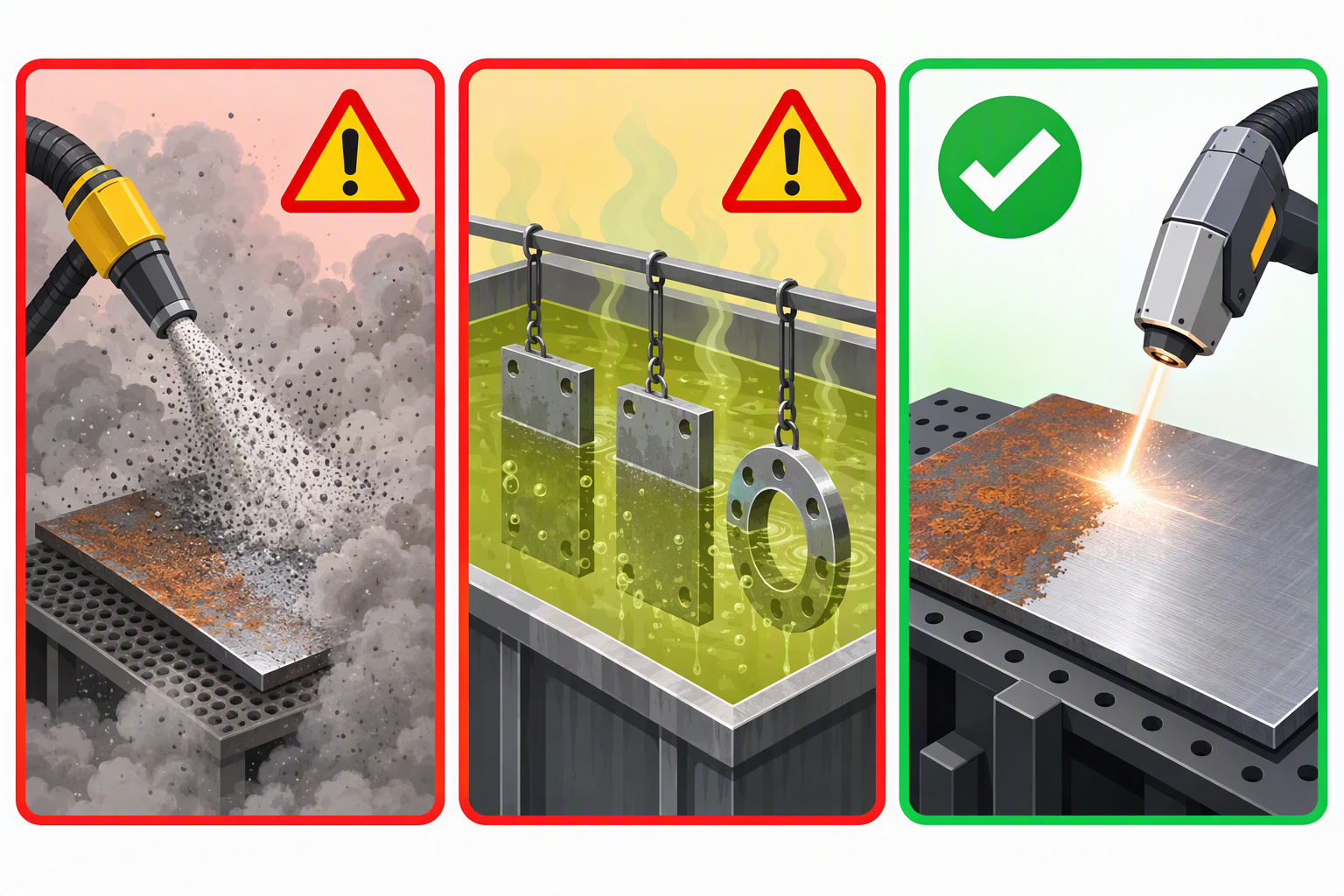
On a 400 m² hull section, blasting is 4.4× faster and wins on labour. Laser wins on total cost only when containment is being rented — and it wins outright on seams, edges, tanks and touch-up.
Buy it for the 5% of the yard where access is expensive. Do not buy it for the 95% where grit already works.

 EN