 ×
Nov 05,2026
You lost a job last month and you are not sure why. This is the arithmetic your competitor used, including the three cases where the answer is no.
It does not mean the machine does three processes at once. It means three stations, three labour hours and three waste streams collapse into one pass at one bench. That is a narrower claim than the marketing version, and it is the only one that survives a stopwatch.
Below is the same 12 m² batch of structural steel, medium rust, run three ways in our own shop. Stopwatch, not brochure.
| Process | Cycle time | Labour | Consumables / m² | Waste stream |
|---|---|---|---|---|
| Sandblasting | 38 min | 2 people | $4.10 (grit, nozzle) | Spent grit, dust, PPE |
| Solvent wipe + grind | 52 min | 2 people | $6.80 (solvent, discs) | VOC, contaminated rags |
| Laser, 1000 W | 14 min | 1 person | $0.42 (electricity, window) | Filter dust only |
Table 1 — Same batch, same rust grade, our shop floor. Sandblasting includes booth set-up and clean-down; laser includes a 3-minute warm-up.
Labour at $22/hour loaded, 1,600 m² a year, and the batch above repeated 133 times. That is a small-to-medium job shop, not a factory — which is exactly the buyer this machine was designed for.
| Per year, 1,600 m² | Sandblast + grind | Laser 1000 W | Delta |
|---|---|---|---|
| Labour hours | 2,240 | 373 | −1,867 |
| Labour cost | $49,280 | $8,206 | −$41,074 |
| Consumables | $10,880 | $672 | −$10,208 |
| Waste disposal | $3,400 | $180 | −$3,220 |
| Machine cost (5-yr amortised) | $1,900 | $3,400 | +$1,500 |
| Annual total | $65,460 | $12,458 | −$53,002 |
| Cost per m² | $40.91 | $7.79 | −81% |
Table 2 — Annual cost model, 1,600 m². Labour is the whole story: 81% of the saving is hours, not consumables.
Three jobs where the machine replaces nothing, and we say so before the order rather than after:
| Case | Why laser loses | What to do instead |
|---|---|---|
| Heavy mill scale, 0.4 mm+, full plate | Two or three passes at 1000 W; blasting still wins on m²/hour | Blast, then laser for the finish pass |
| Large flat plate, 50 m²+ per day | Handheld throughput caps at 8–12 m²/h; a blast line does 40 | Robotic cell or blast line, laser for edges and welds |
| Thin sheet under 0.8 mm | Heat input distorts; parameter window is narrow | Chemical or laser with pulse shaping, tested first |
Table 3 — Where the "one replaces three" claim breaks. A supplier who cannot name these three cases has not run the machine in production.
Not the machine. The learning curve. The first month, a new laser operator is slower than an experienced blaster — 30–40% slower on complex geometry, because he is still learning angle, standoff and overlap. The saving arrives in month two, not week one.
Shops that fail with this machine almost always fail here: they buy it, hand it to the blaster without training, compare week-one throughput to twenty years of blasting experience, and conclude the machine was oversold. It was not. The comparison was.
| Annual area cleaned | Annual saving | Payback on $14,500 | Verdict |
|---|---|---|---|
| 400 m² | $13,250 | 13.1 months | Works, slowly |
| 800 m² | $26,500 | 6.6 months | Comfortable |
| 1,600 m² | $53,000 | 3.3 months | Obvious |
| 3,200 m² | $106,000 | 1.6 months | Buy two |
Table 4 — Payback scaled from Table 2. Below 400 m² a year, hire the service instead of buying the machine.
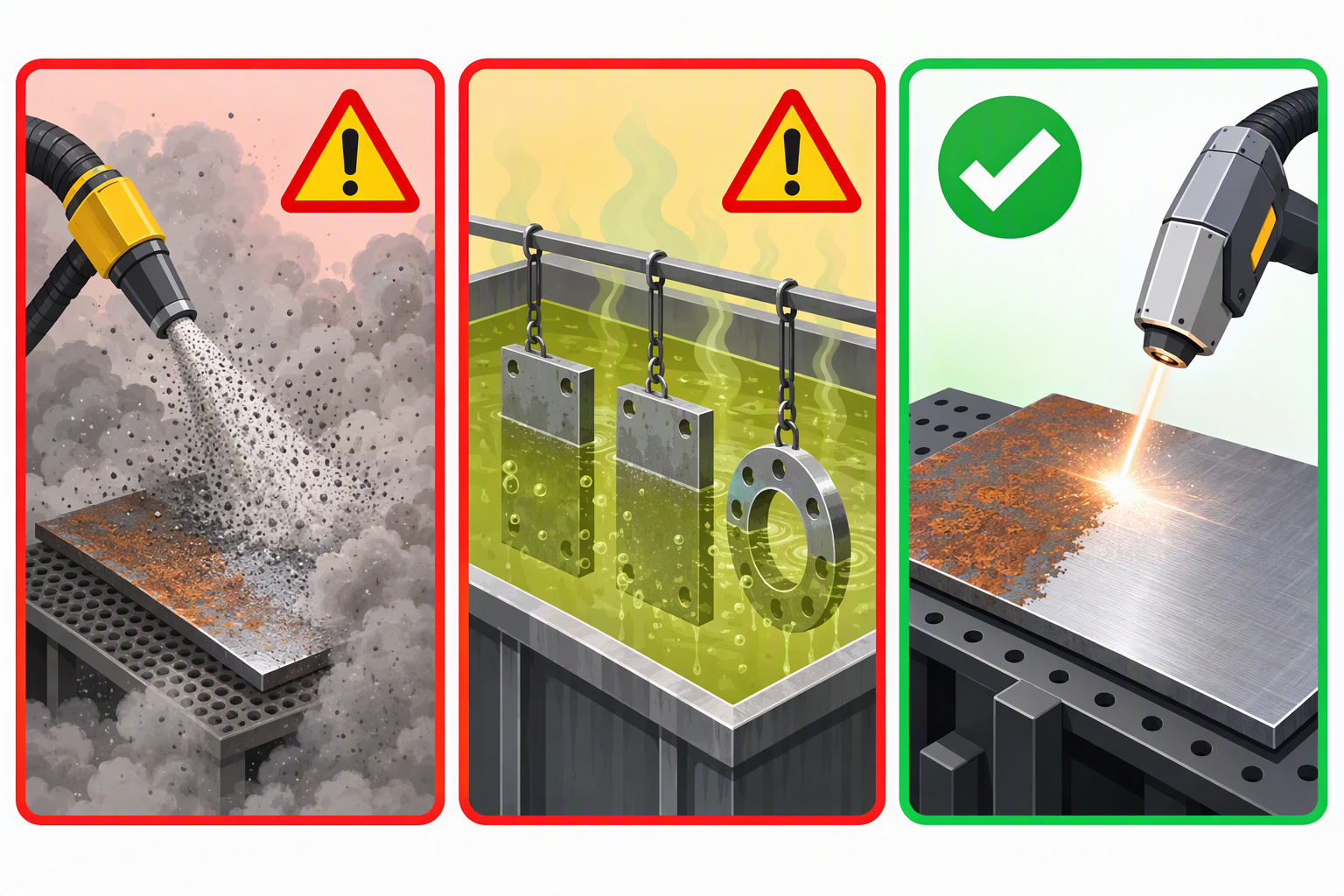
The fear is real and the arithmetic is boring: on mixed geometry at 500–2,000 m² a year, one laser station costs $7.79 a square metre against $40.91 for blast-and-grind. That is not a 38% advantage. It is a different industry.
But it replaces three stations only where three stations were doing the same job badly. On heavy scale, on 50 m² of flat plate, on 0.6 mm sheet, it replaces nothing — and a supplier who will not say that out loud is selling you a number, not a machine.

 EN